What is a Mortgage? Meaning, Types & How IT Works in India 2026

A mortgage loan is a secured loan where a property collateral, allowing borrowers to finance real estate purchases or access funds against existing…

Share

A mortgage loan is a secured loan where a property collateral, allowing borrowers to finance real estate purchases or access funds against existing property. As of 2024, over 60% of Indian borrowers rely on mortgage-backed loans for housing, with demand surging by over 15% in the same year. This financial instrument enables individuals to acquire property without upfront full payment, making homeownership accessible.

The borrower repays the loan in Equated Monthly Instalments (EMIs) over a tenure typically ranging from 5 to 30 years, covering both principal and interest. If the borrower defaults, the lender can legally seize and sell the mortgaged property to recover the outstanding loan amount. Once the loan is fully repaid, the property’s ownership is transferred back to the borrower.

Mortgage loans generally offer lower interest rates compared to unsecured loans, given the security of the pledged property. Interest rates for mortgage loans in India typically range from 8% to 9.5% per annum as of 2024, varying based on factors like the borrower’s credit score, loan amount, and the chosen interest rate type (fixed or floating). The Reserve Bank of India (RBI) mandates specific Loan-to-Value (LTV) ratios, with banks sanctioning 75% to 90% of the property value as a loan, depending on the property’s cost.

Key Aspects of a Mortgage Loan in India

Understanding the fundamental components of a mortgage loan is for Indian borrowers. These loans are structured with specific terms and conditions that govern the agreement between the lender and the borrower.

Aspect Description
Definition A secured loan where real estate (land or home) is pledged as collateral against the borrowed amount.
Collateral The property itself acts as security, reducing risk for the lender.
Lender Typically banks or Non-Banking Financial Companies (NBFCs) in India.
Borrower An Indian citizen, aged 21 to 65 years, who pledges property for funds.
Repayment Made through Equated Monthly Instalments (EMIs) over a defined period.
Tenure Ranges from 5 to 30 years, with most banks offering up to 30 years (RBI, 2026). Urban Cooperative Banks CAP tenure at 20 years (RBI, 2026).
Interest Rate Competitive rates, typically 8% to 9.5% p.a. (as of 2024), can be fixed or variable.
Loan Amount Can be up to ₹10 crore or more, depending on property value and borrower eligibility.
Loan-to-Value (LTV) Ratio The percentage of the property’s market value that the bank can lend. RBI mandates 90% for loans below ₹30 lakh, 80% for ₹30-75 lakh, and 75% for loans above ₹75 lakh (RBI, 2026).
Down Payment The borrower must cover the remaining portion of the property value not covered by the loan. RBI specifies at least 10% for homes up to ₹30 lakh, around 20% for ₹30-75 lakh, and about 25% for properties above ₹75 lakh (RBI, 2026).
Foreclosure Lender’s right to seize and sell the property if the borrower defaults on repayments.
Ownership Transfer Property ownership is fully transferred back to the borrower upon complete loan repayment.
Processing Fees Typically 0.5% to 1% of the loan amount, varying by lender.
Stamp Duty A cost involved in legally registering the mortgage deed, varying by state.
Pre-closure Fees Banks may charge a fee for early repayment, varying by lender and loan type.
Tax Benefits Borrowers can avail tax deductions on interest paid and principal repaid under specific sections of the Income Tax Act.

Mortgage Loan: Key Facts & Overview

A mortgage loan in India is a secured loan where real estate property collateral. As of 2024, mortgage interest rates typically range from 8% to 9.5% per annum, with loan tenures extending from 5 to 30 years. Over 60% of Indian borrowers rely on mortgage-backed loans for housing.

Parameter Details
Definition A secured loan where a property (residential or commercial) is pledged as collateral to borrow funds. The borrower repays the loan in EMIs, and ownership is transferred back upon full repayment.
Purpose Primarily used for purchasing or constructing property, but can also be availed for business needs, renovations, or other large expenditures by leveraging existing property.
Collateral Real estate property (land, home, residential, or commercial property) security for the loan. The lender has a legal claim over the property in case of default.
Repayment Structure Repaid in Equated Monthly Instalments (EMIs) over a fixed period. Payments include both principal and interest.
Interest Rates (As of 2024) Typically range from 8% to 9.5% per annum, varying based on borrower’s credit score, loan amount, tenure, and type (fixed or floating). Current rates vary between 9% and 20% p.a.
Types of Interest Rates Fixed-rate mortgages (rate remains constant), Variable/Floating-rate mortgages (rate fluctuates with RBI’s repo rate), and Adjustable-rate mortgages (fixed for an initial period, then variable).
Loan Tenure Can range from 5 to 30 years, depending on the lender and borrower’s profile. Maximum home loan tenure is up to 30 years for most banks, and 20 years for Urban Cooperative Banks (RBI, 2026).
Maximum Loan Amount Up to ₹10 crore or more, depending on the lender and property value.
Processing Fees Typically 0.5% to 1% of the loan amount.
Applicant Age Limit Minimum 21 years, maximum 65 years (at loan maturity). Some lenders specify 25 years minimum and 75 years maximum.
Loan to Value (LTV) Ratio For loans below ₹30 lakh, LTV is 90%. For properties between ₹30 lakh and ₹75 lakh, LTV is around 80%. For properties above ₹75 lakh, LTV is about 75% (RBI, 2026).
Down Payment (RBI, 2026) At least 10% for homes up to ₹30 lakh, around 20% for properties between ₹30 lakh and ₹75 lakh, and about 25% for properties higher than ₹75 lakh.
Legal Framework (India) Governed by the Transfer of Property Act, 1882, and the Indian Registration Act, 1908. A mortgage deed must be executed on stamp paper and registered.
RBI Repo Rate (February 2026) Stands at 5.25%, influencing floating mortgage rates (RBI Monetary Policy Committee).
Reverse Mortgage Eligibility Available for senior citizens aged 60+ years, with a minimum tenure of 10 years. Property revaluation occurs every 5 years.

Mortgage loans provide significant financial use for property acquisition, with terms and conditions largely regulated by the RBI in India.

Mortgage Deed: Legal Framework & Elements

A mortgage deed is a critical legal document in India, formalizing the agreement between a borrower and lender for a mortgage loan. IT outlines the terms, conditions, and the property pledged as collateral, ensuring legal enforceability under acts like the Transfer of Property Act, 1882. Stamp duty and registration are significant costs, with processing fees typically ranging from 0.5% to 1% of the loan amount.

Element Description Legal Act (India)
Agreement between Lender and Borrower The mortgage deed a legally binding contract outlining the terms and conditions of the mortgage loan. Transfer of Property Act, 1882
Identification of Parties Accurately identifies both the mortgagor (borrower) and mortgagee (lender), ensuring they have the legal capacity to enter into a contract. Indian Contract Act, 1872
Property as Collateral Specifies the real estate property being pledged as security for the loan, granting the lender legal rights over IT in case of default. Transfer of Property Act, 1882
Loan Details Includes the principal loan amount, interest rate, repayment schedule (e.g., EMIs), and any additional fees or penalties. Transfer of Property Act, 1882
Default Clauses Outlines the conditions under which the borrower is considered to be in default and the remedies available to the lender, such as the right to seize and sell the property. Transfer of Property Act, 1882
Redemption Rights Confirms the borrower’s right to reclaim full ownership of the property upon complete repayment of the loan. Transfer of Property Act, 1882
Execution on Stamp Paper The deed must be executed on stamp paper of the appropriate value as per local jurisdiction, with stamp duty being a significant cost. Indian Stamp Act (State-specific variations)
Registration The deed must be registered with the relevant authority (e.g., sub-registrar’s office) to make IT legally binding and enforceable. Indian Registration Act, 1908
Processing Fees Charges levied by the lender for processing the loan application, typically 0.5% to 1% of the loan amount. Not specified (Lender’s discretion)
Pre-closure Fees Penalties charged by banks if the borrower repays the loan before the agreed tenure, varying by lender. Not specified (Lender’s discretion)
Property Valuation An assessment of the property’s market value by the lender to determine the maximum loan amount. Not specified (Lender’s discretion)
Loan Tenure The period over which the loan is to be repaid, typically ranging from 5 to 30 years for mortgage loans in India. Not specified (Lender’s discretion)

The legal framework ensures that both borrowers and lenders are protected, with the mortgage deed serving as the foundational document for property-backed financing in India.

How a Mortgage Loan Works in India

A mortgage loan in India allows individuals to purchase property by using the property itself as collateral. Lenders, typically banks or NBFCs, provide funds that borrowers repay in EMIs over a tenure ranging from 5 to 30 years.

The process involves several key steps, from application and eligibility checks to property valuation and final loan disbursement.

  • Application Submission: Borrowers submit a loan application with required documents, including identity proof, income statements, and property documents.
  • Eligibility Assessment: Lenders evaluate the applicant’s creditworthiness, income stability, existing debts, and age (typically 21 to 65 years).
  • Property Valuation: The pledged property undergoes a valuation to determine its market worth, which influences the maximum loan amount sanctioned.
  • Loan Sanction and Offer: If approved, the lender issues a sanction letter detailing the loan amount, interest rate (e.g., 8% to 9.5% p.a. As of 2024), tenure, and other terms.
  • Legal and Technical Verification: The property’s legal title and technical aspects are verified to ensure clear ownership and structural integrity.
  • Mortgage Deed Execution: A mortgage deed is legally registered, transferring a conditional interest in the property to the lender as security.
  • Loan Disbursement: The sanctioned loan amount, often 75% to 90% of the property value, is disbursed to the borrower or seller.
  • Repayment in EMIs: Borrowers repay the loan through Equated Monthly Instalments (EMIs), which include both principal and interest, over the agreed tenure.
  • Foreclosure Clause: If the borrower defaults on repayments, the lender has the legal right to foreclose and sell the property to recover the outstanding loan amount.
  • Loan Closure: Upon full repayment of the loan, the mortgage is released, and full ownership rights are transferred back to the borrower.

Understanding these steps helps borrowers the mortgage process effectively and secure financing for their property needs.

Types of Mortgage Loans in India

India offers various mortgage loan types, each structured to meet different financial needs and property ownership scenarios. These loans range from standard fixed and variable rate options to specialized products like Loan Against Property (LAP) and Reverse Mortgages, catering to diverse borrower profiles.

Type Key Feature Example/Details
Fixed-Rate Mortgage Loan Interest rate remains constant throughout the loan tenure Provides stable monthly payments, making budgeting easier. Interest calculation is typically on a monthly basis.
Adjustable-Rate Mortgage (ARM) Loan / Variable-Rate Mortgage Loan / Floating Rate Mortgage Loan Interest rate fluctuates based on market conditions and the RBI’s repo rate Initial lower interest rate, but payments can increase or decrease. Beneficial in a growing economy. Interest calculation is typically on a monthly basis.
Loan Against Property (LAP) Borrow funds by pledging residential or commercial property as collateral Also known as a mortgage loan. Loan amount depends on credit score, income, employment, and property value. Interest rates for self-employed applicants start at 9.30%* p.a. (Bajaj Housing Finance, as of 2026).
Reverse Mortgage Loan Does not impose immediate liability on borrowers; recovery begins when the borrower ceases to reside in the property, sells IT, or dies Designed for senior citizens (60+ years) to convert home equity into income without selling the home. Minimum tenure is 10 years.
Simple Mortgage Loan Borrower mortgages immovable asset to avail a loan, lender can take possession if borrower defaults Borrower is allowed to rent or occupy the property. Possession is retransferred upon full repayment. Also referred to as Equity Mortgage.
Usufructuary Mortgage Loan Lender takes possession of the property and collects rents/profits in lieu of interest Not commonly used in India. The borrower does not have to repay the principal or interest separately.
English Mortgage Borrower transfers ownership of the mortgaged property to the lender, with a condition for retransfer upon repayment The transfer of ownership is conditional. If the borrower successfully pays the loan, the sale becomes void.
Mortgage by Conditional Sale Appears as an outright sale of property, but with a condition that the sale becomes void upon repayment of the loan The mortgage deed must clearly state IT is a conditional sale to avoid confusion with a normal sale.
Daily Interest Mortgage Loan Interest is calculated on a daily basis on the outstanding principal balance Interest charge is calculated by dividing the interest rate by 365 days and then by the outstanding mortgage balance.
Second Mortgage Loan An additional loan taken against a property that already has an existing mortgage Lender gives additional required loans based on borrower’s credit score and repayment history. Borrower pays EMIs for both the first and second mortgage loans.

Understanding these distinct mortgage types helps borrowers choose the most suitable option based on their financial stability, risk appetite, and specific property-related goals in India.

Mortgage vs Home Loan: Key Differences

A mortgage loan serves broader financial needs, allowing borrowers to pledge an existing property for funds, whereas a home loan is exclusively for property acquisition. As of 2026, home loans typically offer lower interest rates and more significant tax benefits compared to mortgage loans, which are secured against an already owned asset.

Feature Mortgage Loan Home Loan
Purpose Broader purposes, including business expansion, debt consolidation, higher education, or personal expenses, by pledging an existing property. Specifically for financing the purchase, construction, or renovation of a residential property.
Collateral An existing residential or commercial property owned by the borrower is pledged as collateral. The property being purchased, constructed, or renovated the collateral for the loan.
Interest Rates Generally higher compared to home loans, varying based on factors like credit score, loan amount, and tenure. As of 2024, rates range from 8% to 9.5% p.a. Typically lower compared to other types of loans, including mortgage loans, due to the specific purpose of home ownership.
Tax Benefits Tax benefits may vary depending on the specific purpose for which the loan funds are used. Borrowers can avail of tax benefits on both the principal amount (Section 80C) and the interest paid (Section 24(b)) under the Income Tax Act.
Loan-to-Value (LTV) Ratio Often has a lower LTV ratio compared to home loans, as IT’s against an existing property. Average margin offered by banks is 40-60%. Generally offers a higher LTV ratio, allowing borrowers to finance a larger portion of the property’s value (75% to 90%).
Flexibility Offers more flexibility in terms of how the borrowed funds can be utilized. Less flexible, as the funds are strictly for property-related expenses.
Loan Tenure Typically ranges from 5 to 30 years. Most banks offer up to 30 years, with Urban Cooperative Banks capping at 20 years (per RBI, 2026).
Processing Fees Ranges from 0.5% to 1% of the loan amount, sometimes higher for adjustable-rate mortgages. Generally similar, ranging from 0.5% to 1% of the loan amount.

While both involve property as security, the core distinction lies in their application: mortgage loans use existing assets for diverse financial needs, whereas home loans help new property ownership.

Benefits of a Mortgage Loan

A mortgage loan offers several financial advantages, enabling property ownership and providing access to significant funds. Over 60% of Indian borrowers rely on mortgage-backed loans for housing, their importance in the real estate market.

  • Property Ownership: Mortgage loans allow individuals to purchase property without paying the entire cost upfront, making homeownership accessible.
  • Lower Interest Rates: These loans typically feature lower interest rates compared to unsecured personal loans, due to the property serving as collateral. As of 2025, competitive mortgage loan interest rates range from 8.5% to 12% per annum.
  • Long Repayment Tenure: Borrowers can spread repayments over an extended period, often 5 to 30 years, reducing the monthly EMI burden.
  • Access to Large Funds: Mortgage loans provide substantial financing, with maximum loan amounts reaching up to ₹10 crore or more, depending on the property value and borrower profile.
  • Tax Benefits: Borrowers can claim tax deductions on both the principal and interest components of a mortgage loan under relevant sections of the Income Tax Act. For reverse mortgages, the income received is tax-free.
  • Capital Appreciation: Property purchased with a mortgage can appreciate in value over time, building equity for the borrower.
  • Financial Flexibility: A mortgage loan can also be used as a Loan Against Property (LAP) to meet other financial needs, such as business expansion or education expenses.

These benefits make mortgage loans a strategic financial tool for property acquisition and leveraging existing assets in India.

Mortgage Loan Interest Rates in India 2026

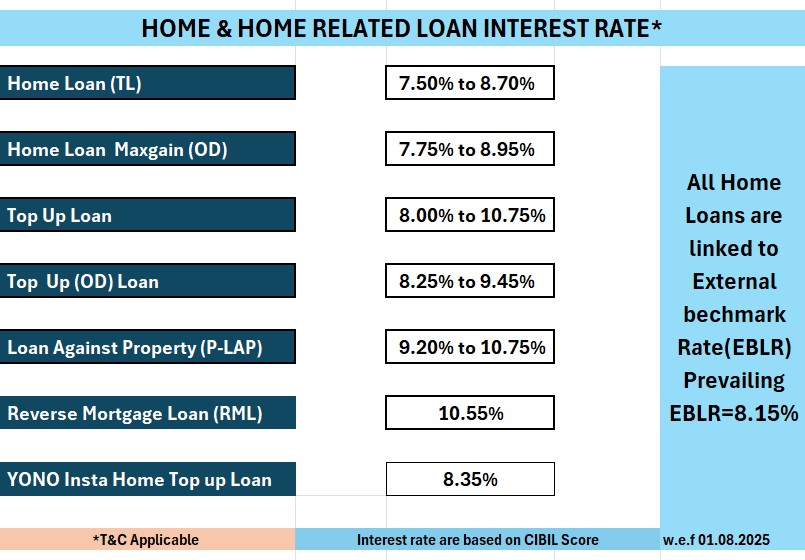
Mortgage interest rates in India typically range from 8% to 9.5% per annum as of 2024, influenced by the borrower’s credit score, loan amount, and tenure. For 2026, competitive rates are projected between 8.5% and 12% p.a., with public sector banks often offering lower starting rates.

Lender/Factor Interest Rate Range (p.a.) Notes
ICICI Bank 7.50%* p.a. (valid till May 31, 2026) Rates linked to repo rate; tiered loan slabs; customised rates based on credit score.
Bajaj Finserv 7.25%* p.a. (June 2026) Lowest interest rates; self-employed borrowers from 7.70%* p.a.; rates depend on CIBIL Score, repayment history, income stability, property details, loan tenure.
Kotak 7.60%* p.a. (2026) Minimum home loan interest rate typically starts around 7.60% p.a. To 8.00% p.a.; rates vary by loan amount, tenure, and applicant’s credit profile; fixed or floating rates available.
HDFC Bank 8.15% p.a. (June 2026) Offers Adjustable Rate Home Loan (ARHL) linked to HDFC Bank’s External Benchmark Lending Rate; TruFixed Loan (fixed for initial 2-3 years, then converts to ARHL).
State Bank of India (SBI) 7.25% p.a. (2026) Public sector banks typically offer the lowest starting rates; actual rates vary depending on credit score, loan amount, employment profile, and internal risk assessment.
Paisabazaar (various banks) 7.1% (2026) Compare housing loan interest rates from top 25+ banks; rates depend on credit score, loan amount, loan tenure, employment type, income stability, and lender’s internal risk assessment.
Self-employed applicants (Bajaj Housing Finance) 9.30%* p.a. Specific rates for self-employed individuals.
Floating Rate Mortgages Varies with RBI repo rate Interest rate fluctuates with changes in the bank’s base rate, directly dependent on the Reserve Bank of India’s repo rate (5.25% as of RBI MPC 2026).
Fixed-cum-Floating Rate Mortgages Fixed initially, then variable Fixed interest rate in the initial stages, then changes based on Indian economy performance.
Loan Against Property (LAP) Higher than home loans Generally comes with higher processing fees and rates compared to standard home loans.
Borrower’s Credit Score Lower rates for CIBIL 750+ A strong CIBIL score significantly impacts the offered interest rate, leading to better terms.
Loan Tenure 5 to 30 years Longer tenures may result in higher overall interest paid, but lower EMIs.

The RBI Monetary Policy Committee (MPC) set the repo rate at 5.25% in 2026, which influences floating mortgage rates across India. Most banks offer maximum home loan tenures of up to 30 years, while Urban Cooperative Banks CAP IT at 20 years.

Key Takeaways

  • Mortgage interest rates in India for 2026 are expected to range from 7.1% to 12% p.a., with public sector banks offering the most competitive starting rates.
  • Key factors influencing your mortgage rate include your CIBIL score, loan amount, chosen tenure (5-30 years), and employment type.
  • The RBI’s repo rate (5.25% as of 2026) directly impacts floating interest rates, making them subject to market fluctuations.

Compare current mortgage loan interest rates from various lenders and check your eligibility at their official websites for the most accurate terms.

Frequently Asked Questions (FAQs)

What is a mortgage loan in India?

A mortgage loan in India is a secured loan where a property is pledged as collateral to the lender. This allows borrowers to finance property purchases or secure funds for other large expenditures, with the property acting as security against the borrowed amount. If the borrower defaults, the lender can recover the loan by selling the mortgaged property.

How does a mortgage loan work in India?

In India, a mortgage loan works by the borrower receiving a lump sum from a bank or NBFC, which is then repaid in Equated Monthly Instalments (EMIs) over a set tenure. The property remains mortgaged to the lender until the full loan amount, including interest, is repaid. Loan tenures typically range from 5 to 30 years, as seen with lenders like HDFC Bank and SBI.

What are the common types of mortgage loans in India?

The most common types of mortgage loans in India include home loans for property purchase, loans against property (LAP) for various financial needs, and reverse mortgage loans for senior citizens. Home loans are typically for buying or constructing a house, while LAP uses an existing property as collateral for funds. Reverse mortgages provide income to seniors against their home equity.

What are the typical interest rates for mortgage loans in India?

As of early 2026, mortgage interest rates in India typically range from 8.5% to 10.5% per annum. These rates vary based on factors like the borrower’s CIBIL score, loan amount, and the chosen interest rate type (fixed or floating). For example, a CIBIL score above 750 generally secures lower rates from major banks like ICICI and Axis Bank.

What is the maximum tenure for a mortgage loan in India?

The maximum tenure for a mortgage loan in India can extend up to 30 years, depending on the lender and the borrower’s profile. Longer tenures result in lower EMIs but higher overall interest paid. Most banks, including SBI and HDFC, offer flexible tenures to suit different repayment capacities.

Can I get tax benefits on a mortgage loan in India?

Yes, borrowers can avail significant tax benefits on mortgage loans in India under various sections of the Income Tax Act, 1961. This includes deductions on interest paid under Section 24(b) and on principal repayment under Section 80C. As of the current financial year, the maximum deduction for interest on a self-occupied property is ₹2 lakh annually.

What happens if I default on a mortgage loan in India?

If you default on a mortgage loan in India, the lender has the right to initiate recovery proceedings, which can include taking possession of and selling the mortgaged property. This process is governed by the SARFAESI Act, 2002, allowing banks to recover dues without court intervention in certain cases. Defaulting also severely impacts your CIBIL score.


Disclaimer: This article is general information, not financial advice. Interest rates, fees, and eligibility change frequently. Verify current details with the lender or regulator (RBI / SEBI) before deciding.