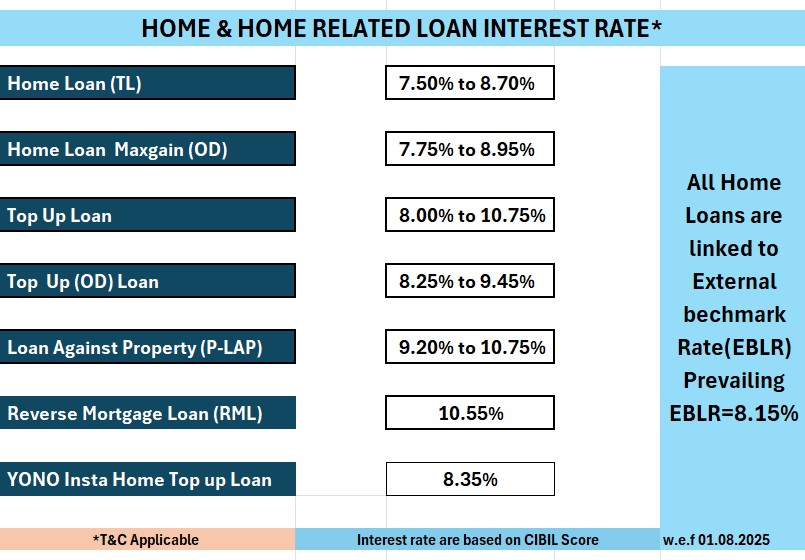
Home loan interest rates in India typically range from 7.10% to 13.00%+ p.a. As of June 2026. Public sector banks often offer the lowest starting rates, with some beginning at 7.10% p.a. For eligible borrowers. A CIBIL score of 750 or above is for securing the most competitive rates.
| Parameter | Details (As of June 2026) |
|---|---|
| Average Annual Home Loan Rate (2013-2023) | 8.82% |
| Current RBI Repo Rate | 5.25% (April 2026, unchanged as per MPC meeting April 8, 2026) |
| Lowest Starting Home Loan Interest Rate | 7.10% p.a. (offered by select public sector banks) |
| Typical Home Loan Interest Rate Range | 7.10% – 13.00%+ p.a. |
| CIBIL Score for Lowest Rates | 750 or above |
| Fixed Home Loan Rates (Starting) | 9.50% p.a. Or higher (April 2026) |
| Floating Home Loan Rates (Self-Employed) | 7.70% p.a. (starting) |
| Interest Rate Concessions for Women Borrowers | 0.05% to 0.50% (for women borrowers or joint applications) |
| Home Loan Coverage for Property Value | Up to 90% (for purchasing land or plots) |
| Home Loan Transfer Completion Time | 15-30 days (most lenders) |
| Processing Fees (Typical Range) | 0.25% to 1% of the loan amount |
| Prepayment Charges on Floating-Rate Loans | Cannot levy for non-business purposes to individuals (per RBI Directions 2025, effective Jan 1, 2026) |
| Standing Deposit Facility (SDF) Rate | 5.00% (RBI MPC, April 8, 2026) |
| Marginal Standing Facility (MSF) / Bank Rate | 5.50% (RBI MPC, April 8, 2026) |
| SBI’s EBLR (External Benchmark Lending Rate) | 7.90% (Repo Rate 5.25% + Spread 2.65%, April 2026) |
The RBI’s repo rate directly influences floating home loan rates, with banks typically adjusting their rates within three months of any RBI policy change. Economic factors like inflation and employment levels also play a role in setting base interest rates.
Bank-Wise Home Loan Interest Rates (2026)
Home loan interest rates in India typically range from 7.10% to 13.00%+ p.a. As of June 2026. Public sector banks often offer the lowest starting rates, with some beginning at 7.10% p.a. For eligible borrowers with strong CIBIL scores of 750 or above.
| Bank Name | Starting Interest Rate (p.a.) | Salaried (Min) | Self-Employed (Min) | CIBIL Score Requirement |
|---|---|---|---|---|
| Bank of Baroda | 6.85% (April 2026) | Not specified | Not specified | 750 or above |
| Kotak Mahindra Bank | Not specified | Age 18-60 years | Age 18-65 years | Not specified |
The actual interest rate offered depends on factors like your CIBIL score, loan amount, tenure, and the lender’s internal risk assessment policies.
Lowest Home Loan Interest Rates by Bank
As of June 2026, several public sector banks offer the lowest home loan interest rates, starting from 7.10% p.a. For eligible borrowers. A CIBIL score of 750 or above is typically required to access these preferential rates from most lenders.
| Bank Name | Lowest Rate (p.a.) | Borrower Type | Key Feature |
|---|---|---|---|
| Bank of Baroda | 6.85% (April 2026) | All | Lowest rate among all banks, free accident insurance on all loans. |
| Bank of India | 7.10% | All | Competitive starting rate, among public sector banks. |
| Central Bank of India | 7.10% (April 2026) | All | Competitive rate among public sector banks. |
| Indian Overseas Bank | 7.10% (April 2026) | All | Competitive rate among public sector banks. |
| Bank of Maharashtra | 7.10% | All | Among lenders offering lowest rates. |
| Union Bank of India | 7.35% (starting) | All | Among top 5 banks with best home loan rates. |
| State Bank of India (SBI) | 7.25% (2026) | All | Rates linked to repo rate, wide reach and trust. |
| Bajaj Finserv | 7.25% (June 2026) | Salaried | Attractive floating rates for self-employed starting at 7.70% p.a. |
| ICICI Bank | 7.50% (2026) | All | Rates linked to repo rate, valid till May 31, 2026. |
| HDFC Bank | 7.75% (June 2026) | All | Offers Adjustable and Trufixed loan options. |
| Federal Bank | 9.00% – 9.50% | All | Processing time within 1 month for loans up to ₹18 lakh. |
| LIC Housing Finance | 8.80% | All | Low document submission for loans up to ₹27 lakh for 20 years. |
These rates are indicative and can vary based on the borrower’s CIBIL score, loan amount, tenure, and employment type. Always verify the latest rates directly with the bank.
Fixed Vs. Floating Interest Rates
Choosing between fixed and floating home loan interest rates impacts your monthly EMI and overall loan cost. As of June 2026, floating rates typically start lower, around 7.10% p.a. From public sector banks, while fixed rates generally begin at 9.50% p.a. Or higher.
| Feature | Fixed Rate | Floating Rate |
|---|---|---|
| Interest Rate Fluctuation | Remains consistent throughout the loan tenure, no variability in interest charges. | Fluctuates over time based on market conditions or benchmark rates (e.g., RBI repo rate, MCLR). |
| Initial Interest Rate | Typically 1.5% to 2% higher than floating rates, or between 9.50% and 11% (2026). | Generally offered at a lower rate than fixed-rate home loans, ranging from 7.10% to 7.50% for public sector banks (2026) and 7.80% to 8.50% for private lenders (2026). |
| EMI Stability | EMIs remain constant over the entire repayment period, offering stability and predictability in monthly budgeting. | EMIs may increase or decrease during the loan tenure as the interest rate changes. |
| Market Rate Changes | Borrower does not benefit if market rates drop, but is shielded if rates rise. | Borrower benefits if market rates drop, but EMIs increase if rates rise. |
| Prepayment Penalties | Often comes with prepayment penalties (e.g., 2% plus taxes on principal outstanding for fixed-rate loans). | Allows for penalty-free prepayments for individuals on floating-rate loans for non-business purposes, per RBI’s 2025 directions. |
| Risk Bearing | Lenders take on the ‘interest rate risk’. | Borrower bears the ‘interest rate risk’. |
Floating rates are linked to external benchmarks like the RBI repo rate, offering potential savings if rates fall, risk if they rise. Fixed rates provide payment certainty, shielding borrowers from market volatility.
Factors Affecting Home Loan Rates
Several factors influence the home loan interest rate a borrower receives in India. Lenders assess various aspects of an applicant’s financial profile and the loan itself. As of June 2026, typical home loan rates range from 7.10% to 13.00%+ p.a., with specific rates determined by these factors.
- Credit Score: A CIBIL score of 750 or above generally qualifies borrowers for the lowest interest rates. Lenders view high scores as indicative of responsible repayment behavior.
- Loan Amount: Interest rates can vary based on the loan amount. Some banks offer different rates for loans up to ₹30 lakh, between ₹30 lakh and ₹75 lakh, and above ₹75 lakh.
- Loan-to-Value (LTV) Ratio: The LTV ratio, or the percentage of the property’s value financed by the loan, impacts rates. A lower LTV (higher down payment) often results in better rates due to reduced risk for the lender.
- Applicant’s Employment Type: Salaried individuals often receive slightly lower rates compared to self-employed individuals. For example, Kotak Mahindra Bank charges 0.5% processing fee for salaried vs. 1% for self-employed.
- Income Stability: A steady and verifiable income source is . Lenders like Canara Bank require salaried individuals to have a minimum of 2 years of continuous service.
- Property Location and Type: The location, age, and other risk factors associated with the property itself can influence the interest rate. Lenders assess the marketability and condition of the collateral.
- Gender of Applicant: Many banks offer interest rate concessions, typically ranging from 0.05% to 0.50%, for women borrowers or joint applications with women co-applicants.
- Relationship with Lender: Existing customers with a strong banking relationship may sometimes receive preferential interest rates or processing fee waivers from their primary bank.
Understanding these factors helps borrowers optimize their application to secure the most favorable home loan interest rates available in 2026.
How to Get the Lowest Home Loan Rate
Securing the lowest home loan interest rate in India requires strategic planning and a strong financial profile. As of June 2026, rates start from 7.10% p.a. For eligible borrowers with excellent credit scores from select public sector banks.
Optimising your application can significantly reduce your overall interest burden over the loan tenure.
- Maintain a High CIBIL Score: A CIBIL score of 750 or above is for unlocking the most competitive home loan rates. Lenders view high scores as an indicator of low credit risk.
- Increase Your Down Payment: Paying a larger down payment reduces the loan amount, lowering the lender’s risk and potentially qualifying you for a better interest rate. Banks typically cover up to 90% of the property value for land or plot purchases.
- Opt for Floating Interest Rates: Floating rates often start lower than fixed rates and can decrease if the RBI repo rate falls. For instance, the RBI repo rate was 5.25% in April 2026, following a 25 basis point cut in December 2025.
- Compare Multiple Lenders: Always compare offers from various banks and Housing Finance Companies (HFCs). Public sector banks like Indian Overseas Bank, Bank of Maharashtra, and Central Bank of India offer rates starting around 7.10% p.a. As of June 2026.
- Negotiate with Your Bank: If you have a long-standing relationship with your bank, a strong credit history, and a good income, you may be able to negotiate for a lower interest rate or reduced processing fees.
- Consider a Balance Transfer: If you have an existing home loan at a higher rate, transferring IT to a new lender offering a lower rate can save you money. Be aware of processing fees and other administrative charges, which can range from 0.5% to 1% of the outstanding amount.
- Apply with a Woman Co-Applicant: Many lenders offer interest rate concessions, typically ranging from 0.05% to 0.50%, for home loans applied for by women borrowers or jointly with a woman co-applicant.
By focusing on these key areas, you can significantly improve your chances of securing the most favourable home loan interest rate available in 2026.
Home Loan Balance Transfer: Savings
A home loan balance transfer allows you to shift your existing loan to a new lender, potentially securing a lower interest rate. This can significantly reduce your total interest paid and lower monthly EMIs over the remaining tenure. However, transfer costs like processing fees must be weighed against the potential savings.
| Parameter | Details | Potential Savings |
|---|---|---|
| Purpose of Balance Transfer | Transferring an existing home loan from one bank or lender to another. | Lower interest rates, reduced EMIs, or improved loan terms, leading to a lesser overall cost of the loan. |
| Interest Rate Reduction | New lender offers a lower interest rate compared to the existing loan. | Significant reduction in total interest paid over the loan tenure and lower monthly EMIs. |
| EMI Management | Option to either reduce EMI while keeping tenure same, or reduce tenure while keeping EMI same. | Easier to manage monthly repayments or faster loan repayment. |
| Associated Costs | Processing fees (typically 0.5% to 1% of outstanding amount), legal and technical evaluation charges, potential prepayment penalties from existing lender. | Savings are realized only if the reduction in interest outweighs these transfer costs. |
| Top-up Loan Facility | Many lenders offer an additional top-up loan during the balance transfer. | Access to additional funds for home repairs, renovations, or other needs, often at the same competitive home loan interest rate. |
| Processing Fees (SBI) | 0.35% to 0.50% of the loan amount. | Consider this cost against interest savings; for a ₹50 lakh loan, this is ₹17,500 to ₹25,000. |
| Processing Fees (Canara Bank) | Up to 0.50% of the loan amount, with a maximum of ₹10,000 and a minimum of ₹1,500. | A capped fee can make transfers more attractive for larger loan amounts. |
| Processing Fees (Union Bank of India) | 0.50% of the loan amount, capped at ₹15,000 + GST. | The CAP limits the upfront cost, potential savings for high-value loans. |
| Preclosure Charges (Floating Rate Loan) | ₹0 for individuals on floating rate loans for non-business purposes, as per RBI’s Pre-payment Charges on Loans Directions 2025. | No penalty from your existing lender for moving a floating-rate loan. |
| Preclosure Charges (Fixed Rate Loan) | 2% plus applicable taxes on principal outstanding. | This fee must be factored into the overall cost-benefit analysis of transferring a fixed-rate loan. |
| Transfer Completion Time | Typically 15-30 days for most lenders. | A relatively quick process allows for faster realization of interest rate benefits. |
| CIBIL Score Impact | A CIBIL score of 750 or above is for securing the lowest rates from the new lender. | Higher credit scores directly translate to better interest rate offers and greater savings. |
A balance transfer can lead to substantial savings, especially if your current interest rate is significantly higher than prevailing market rates. Always compare the new interest rate against all associated transfer fees to ensure a net benefit.
RBI Repo Rate Impact on Home Loans
The Reserve Bank of India (RBI) repo rate significantly influences home loan interest rates in India. As of April 2026, the RBI’s Monetary Policy Committee (MPC) maintained the repo rate at 5.25%, following a 25 basis point cut in December 2025. This benchmark rate directly impacts the floating interest rates offered by banks and Housing Finance Companies (HFCs).
Home loan interest rates are typically composed of a benchmark rate plus an additional spread set by the lender. Any revision in the RBI’s repo rate can directly affect a borrower’s EMI or loan tenure. For instance, SBI’s External Benchmark Lending Rate (EBLR) was 7.90% in April 2026, calculated as the Repo Rate (5.25%) plus a spread (2.65%).
The RBI’s MPC is scheduled to meet from June 3 to 5, 2026, to review monetary policy. Changes in the repo rate can lead to adjustments in home loan rates, with public sector banks often offering rates starting from 7.10% p.a. For eligible borrowers with high CIBIL scores (750+).
Key Takeaways
- The RBI repo rate, at 5.25% as of April 2026, directly influences floating home loan interest rates across Indian banks.
- Home loan interest rates are a sum of the RBI’s benchmark rate and a lender-specific spread, impacting EMIs and loan tenures.
- Public sector banks currently offer some of the lowest home loan rates, starting from 7.10% p.a. For borrowers with strong credit profiles.
Compare current home loan offers from various banks and check your eligibility to secure the most favorable rates for your financial needs.
Frequently Asked Questions (FAQs)
What is a home loan interest rate?
A home loan interest rate is the charge a bank or housing finance company applies to the amount borrowed for buying or refinancing a home. This rate determines your monthly EMI payments over the loan tenure. IT is typically a sum of a benchmark rate and an additional spread set by the lender.
How are home loan interest rates determined in India?
Home loan interest rates in India are determined by a benchmark rate (like the RBI’s repo rate or MCLR) plus a spread set by the individual lender. The Reserve Bank of India (RBI) monitors and guides these rates. Any changes in the benchmark rate directly impact your EMI or loan tenure.
Which banks offer the lowest home loan interest rates in India?
Public sector banks generally offer some of the lowest home loan interest rates in India. As of June 2026, lenders like Canara Bank and State Bank of India often feature competitive rates, starting from around 7.10% p.a. For eligible borrowers. Always compare current offers from multiple banks like HDFC Bank, ICICI Bank, and Axis Bank.
Does my CIBIL score affect my home loan interest rate?
Yes, your CIBIL score significantly affects the home loan interest rate you qualify for. A CIBIL score above 750 typically helps you secure the lowest available rates from most Indian banks. Lenders consider a higher score indicative of lower credit risk, leading to better terms.
What is the difference between fixed and floating interest rates for home loans?
A fixed interest rate remains constant throughout the loan tenure, providing predictable EMIs. A floating interest rate, however, fluctuates based on market conditions and benchmark rates like the RBI’s repo rate. Most home loans in India are offered with floating rates, which can change periodically.
Can I transfer my home loan to another bank for a lower interest rate?
Yes, you can transfer your existing home loan to a new lender offering a lower interest rate through a balance transfer. This process is treated as a new loan, so processing fees and other administrative charges apply. Evaluate the total savings against these costs before opting for a transfer.
What documents are required to apply for a home loan in 2026?
To apply for a home loan in 2026, you will typically need identity proof (PAN card, Aadhaar), address proof, income documents (salary slips, bank statements, ITR), and property-related documents. Lenders like SBI and HDFC Bank require these for eligibility assessment. Always check the specific list with your chosen bank.
Disclaimer: This article is general information, not financial advice. Interest rates, fees, and eligibility change frequently. Verify current details with the lender or regulator (RBI / SEBI) before deciding.