India’s housing credit grew over 16% in FY18, with home loans being a significant financial commitment for many. As of 2026, a home loan EMI calculator helps borrowers estimate monthly payments and plan their finances effectively. This tool is for understanding the financial implications of a loan up to ₹50 lakh or more.
| Parameter | Details |
|---|---|
| What is a Home Loan EMI Calculator? | An online tool that calculates your monthly home loan payments (EMI). IT estimates the exact amount needed to repay the home loan each month. |
| Components of EMI | EMI (Equated Monthly Installment) includes both principal repayment and interest payment. This sum is divided by the loan tenure in months. |
| Key Variables for Calculation | The calculator uses the principal loan amount, the interest rate (fixed or floating), and the loan tenure (in months or years). |
| How EMI Components Change Over Time | Early EMIs have a larger interest portion and a smaller principal component. Over time, the interest portion decreases, and the principal portion increases. |
| Benefits for Financial Planning | Helps plan cash flows, make informed decisions about home purchases, and understand the impact of changing property prices or interest rates. |
| Amortization Schedule | Many calculators generate a detailed amortization schedule. This table shows the month-by-month split of each EMI into principal and interest. |
| Choosing Loan Tenure | The calculator helps borrowers choose the right tenure. A shorter tenure means higher EMIs but faster repayment; a longer tenure (up to 30 years) reduces EMIs. |
| Accuracy and Time-Saving | IT instantly and accurately performs complex calculations, saving prospective borrowers significant time in financial planning. |
| Maximum Repayment Tenure | Home loans in India can have a maximum repayment tenure of up to 30 years. |
| Fixed Home Loan Rates (2026) | Starting from 9.50% p.a. Or higher, offering EMI certainty for a set period (typically 2-5 years). |
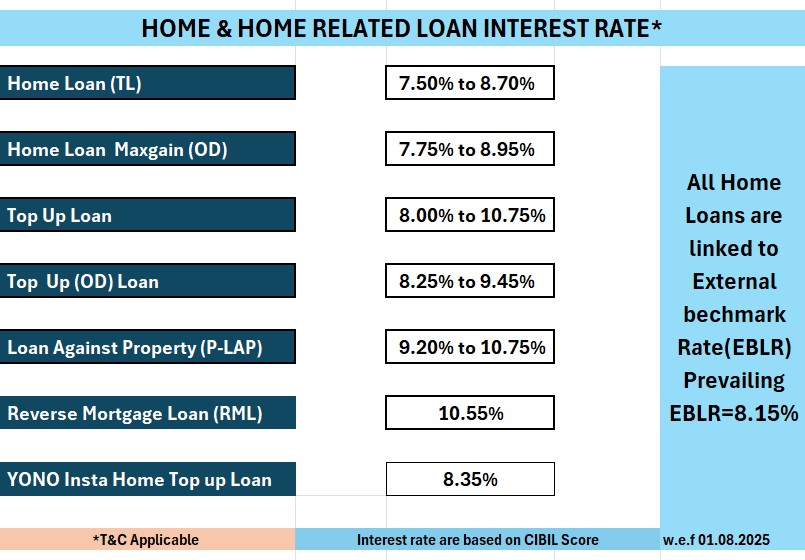
| SBI’s EBLR (2026) | SBI’s External Benchmark Lending Rate (EBLR) is 7.90%, comprising a Repo Rate component of 5.25% and a spread of 2.65%. |
| SBI Home Loan Rates (2026) | Starting from 7.50% p.a. For eligible borrowers. |
Using an EMI calculator allows borrowers to compare various loan scenarios, such as different interest rates or tenures, to find a repayment plan that aligns with their financial capacity for 2026.
How Home Loan EMI Calculator Works: Formula, Inputs & Instant Results
A home loan EMI calculator uses a specific mathematical formula to determine your monthly payment, taking into account the principal loan amount, interest rate, and tenure. This tool provides instant results, helping you understand your financial commitment before applying for a home loan in India.
The calculator relies on three key inputs to generate your Equated Monthly Instalment (EMI) and an amortization schedule:
- Principal Loan Amount (P): This is the total amount of money you borrow from the bank or financial institution. For example, a loan of ₹50 lakh at 7.35% p.a. For 25 years results in an EMI of ₹36,359.
- Interest Rate (R): This is the annual interest rate charged by the lender, which is converted into a monthly rate for the calculation. As of 2026, fixed home loan rates start from 9.50% p.a. Or higher.
- Loan Tenure (N): This represents the total duration over which you will repay the loan, expressed in months. Home loan tenures can extend up to 30 years, significantly impacting the total interest paid.
- EMI Formula: The standard formula used is E = [P x R x (1+R)N] / [(1+R)N-1]. Here, ‘E’ is the EMI, ‘P’ is the principal, ‘R’ is the monthly interest rate (annual rate divided by 12 and then by 100), and ‘N’ is the tenure in months.
- Monthly Interest Rate Calculation: If the annual interest rate is 7.50% p.a., the monthly rate (R) becomes 7.50 / 12 / 100 = 0.00625. This ‘R’ value is for accurate EMI calculation.
- Reducing Balance Method: The calculator applies the reducing balance method, where interest is charged only on the outstanding principal amount each month. This means the interest component of your EMI decreases over time.
- Instant Results: By inputting these three values, the calculator instantly displays your EMI, total interest payable, and the total repayment amount over the chosen tenure. For a ₹20 lakh loan at 7.99% p.a. For 20 years, the EMI is approximately ₹16,729.
- Amortization Schedule: Many advanced calculators also generate a detailed amortization schedule, showing how each EMI payment is split between principal and interest over the loan’s lifetime. Early EMIs typically have a higher interest component.
Understanding these components helps borrowers effectively plan their finances and choose a home loan that aligns with their repayment capacity.
Home Loan EMI Calculation Example: ₹20 Lakh Loan at 7.99% for 20 Years
Calculating your home loan EMI helps in financial planning and budgeting for your property purchase. For a ₹20 lakh home loan at 7.99% p.a. Over 20 years, the estimated EMI is ₹16,729, as per PNB Housing Finance data.
| Metric | Value | Source |
|---|---|---|
| Principal Loan Amount (P) | ₹20,00,000 | PNB Housing Finance |
| Annual Interest Rate | 7.99% p.a. | PNB Housing Finance |
| Loan Tenure (N) | 20 Years (240 months) | PNB Housing Finance |
| Monthly Interest Rate (R) | 0.00667 (calculated from 8.00/100/12) | PNB Housing Finance |
| Calculated Monthly EMI | ₹16,729 | PNB Housing Finance |
| Total Repayment Amount | ₹40,14,960 (approx.) | Calculated from EMI |
| Total Interest Payable | ₹20,14,960 (approx.) | Calculated from EMI |
| Maximum Home Loan Tenure | Up to 30 years | Industry Standard |
| RBI Repo Rate (2026) | 5.25% | RBI Monetary Policy Committee (MPC) |
| SBI’s EBLR (2026) | 7.90% | SBI (Repo Rate component 5.25% + Spread 2.65%) |
This example demonstrates how the principal, interest rate, and tenure combine to determine your monthly payment and overall interest cost. A longer tenure reduces the EMI but increases the total interest paid over the loan period.
Understanding Your Home Loan Amortization Schedule: Principal vs Interest Split
A home loan amortization schedule details how each EMI payment is divided between principal and interest over the loan tenure. In the initial years, a larger portion of your EMI goes towards interest, while later years see a greater share allocated to principal repayment. This split significantly impacts your outstanding balance and total interest paid.
| Loan Year | Opening Balance (₹) | Interest Paid (₹) | Principal Paid (₹) | Closing Balance (₹) |
|---|---|---|---|---|
| Initial years | Large | Major portion of EMI | Smaller portion of EMI | Decreasing |
| Early in the loan term | High | Larger portion of payment | Smaller portion of payment | Decreasing |
| Each month | Outstanding balance | Charged only on outstanding balance | Increases over time | Decreases |
| Over time | Decreasing | Decreases with each successive payment | Increases with each successive payment | Decreasing |
| As loan tenure progresses | Decreasing | Keeps decreasing | Increases | Decreasing |
| Later years | Smaller | Decreasing portion of EMI | Increasing portion of EMI | Approaching zero |
This shifting principal-interest split means that early prepayments can significantly reduce your total interest burden over the loan’s lifetime.
Home Loan EMI Calculator: Benefits: Planning, Budgeting & Smart Financial Decisions
A home loan EMI calculator helps borrowers make informed financial decisions in 2026. IT provides a clear view of monthly payments, total interest, and the amortization schedule, for long-term financial planning.
This tool allows you to compare different loan scenarios, such as a ₹20 lakh loan at 7.99% p.a. For 20 years, which results in an EMI of ₹16,729, aiding in effective budgeting.
- Accurate EMI Estimation: The calculator instantly provides your exact monthly EMI based on the principal, interest rate, and tenure. This helps you understand your monthly financial commitment for up to 30 years.
- Budgeting and Financial Planning: Knowing your precise EMI allows for better household budgeting, ensuring you can comfortably manage loan repayments alongside other expenses. For example, a salaried individual earning ₹40,000 monthly can assess affordability.
- Interest Cost Analysis: The tool breaks down the total interest payable over the loan tenure, such as ₹59.27 lakh interest on a ₹50 lakh loan at 7.35% for 25 years. This the long-term cost of borrowing.
- Amortization Schedule Generation: IT creates a detailed month-by-month schedule showing the principal and interest split for each EMI payment. This helps you track how your loan balance reduces over time.
- Comparison of Loan Offers: You can input different interest rates (e.g., SBI’s starting rate of 7.50% p.a. As of 2026) and tenures from various lenders to find the most suitable option. This comparison helps secure better terms.
- Prepayment Strategy Evaluation: The calculator helps assess the impact of prepayments on your total interest savings and loan tenure reduction. This is for maximising savings, especially with RBI’s 2014 prepayment rules for banks.
- Tax Benefit Planning: Understanding your principal and interest components helps in planning for tax deductions under sections like 80C and 24(b) of the Income-tax Act, 2025 (effective April 1, 2026).
Using a home loan EMI calculator empowers borrowers to plan their finances effectively and make smart decisions regarding one of their largest investments.
Home Loan EMI Calculator: Vs Prepayment Calculator: Maximise Savings in 2026
A Home Loan EMI Calculator determines your monthly payment and total interest for a new loan. In contrast, a Home Loan Prepayment Calculator helps estimate interest savings from making extra payments on an existing loan, potentially reducing tenure or EMI.
Understanding the distinction between these two tools is for effective home loan management and maximizing financial savings in 2026.
| Feature | Home Loan EMI Calculator | Home Loan Prepayment Calculator |
|---|---|---|
| Primary Purpose | Calculates monthly loan payments (EMI), total interest, and total payable amount for a home loan. | Estimates savings from making extra payments (prepayments) on a home loan, showing revised tenure or EMI. |
| Key Inputs | Loan amount, interest rate, loan tenure (in years/months). | Outstanding loan amount, current interest rate, remaining tenure, extra prepayment amount. |
| Key Outputs | Monthly EMI, total interest payable, total repayment amount, amortization schedule (principal/interest split). | Revised loan tenure, revised EMI (if chosen), total interest saved, net savings compared to original schedule. |
| Decision Support | Helps in financial planning, choosing the right loan tenure, and comparing different loan offers. | Helps decide whether to reduce tenure or EMI, and whether surplus funds are better for prepayment or other investments. |
| Benefit Focus | Provides clarity on monthly financial commitments and overall loan cost. | Maximizes savings on total interest paid and helps achieve debt-free status faster. |
| Amortization Schedule | Generates a detailed schedule showing principal and interest components of each EMI over time. | Recalculates the amortization schedule based on the prepayment, showing the impact on future payments. |
| Usage Scenario | Used before taking a new loan or refinancing to assess affordability. | Used during the loan tenure to evaluate the impact of making additional payments. |
| Regulatory Context | Helps borrowers understand loan terms as per RBI guidelines for transparency. | Supports informed decisions on prepayment, aligning with RBI’s 2014 rules on floating rate loan prepayments. |
Using a prepayment calculator can significantly reduce your total interest outflow, especially for long-tenure home loans, by allowing you to strategically apply surplus funds.
Fixed vs Floating Interest Rates: How They Impact Your Home Loan EMI
Indian home loan borrowers often choose between fixed and floating interest rates, which directly affect monthly EMI payments. As of 2026, fixed rates typically start from 9.50% p.a. Or higher, offering payment stability. Floating rates, like SBI’s EBLR at 7.90% (comprising a 5.25% repo rate and 2.65% spread), offer lower initial EMIs but carry market risk.
| Rate Type | Key Feature | EMI Impact | Common Tenure |
|---|---|---|---|
| Fixed Interest Rate | Interest rate remains constant throughout a predetermined period or entire loan tenure | Predictable and constant EMIs, protection from rising interest rates, easier financial planning | Typically 2-5 years fixed, or entire loan tenure (up to 30 years) |
| Floating Interest Rate | Interest rate fluctuates based on market benchmarks (e.g., RBI repo rate) | EMIs can increase or decrease with market rate movements, lower starting rates, benefit if rates fall | Long-term (15-25 years) often saves more |
| Fixed Interest Rate | Lenders take on interest rate risk, charging a premium from day one | Slightly higher starting rates compared to floating rates, no benefit if market rates drop | Set period, often 2-5 years |
| Floating Interest Rate | Linked to external benchmarks like the RBI’s repo rate (e.g., SBI’s EBLR at 7.90% as of 2026) | Unpredictable EMIs and total interest outgo, variability can affect monthly cash flow, upward risks if rates rise | Long-term variability, up to 30 years |
| Hybrid Rate Home Loans | Combines a fixed rate for an initial period (e.g., 2-3 years) followed by a floating rate | Offers initial stability with potential for lower rates later; balances risk and predictability | Initial fixed period (e.g., 2-3 years), then floating for the remaining tenure |
Most Indian borrowers opt for floating rates over long tenures, as they tend to be cheaper overall despite EMI fluctuations.
Key Takeaways
- Fixed home loan rates offer EMI stability but typically start higher, around 9.50% p.a. Or more as of 2026.
- Floating rates, like SBI’s EBLR at 7.90% in 2026, provide lower initial EMIs but expose borrowers to market rate changes.
- For a ₹20 lakh loan at 7.99% for 20 years, the EMI is approximately ₹16,729, with early payments heavily weighted towards interest.
Use a home loan EMI calculator to compare fixed and floating rate scenarios for your specific loan amount and tenure.
Frequently Asked Questions (FAQs)
How does a home loan EMI calculator work in India?
A home loan EMI calculator in India uses a mathematical formula (EMI = P × r × (1+r)^n / ((1+r)^n – 1)) to compute your monthly payment. You input the principal loan amount, interest rate, and loan tenure, and IT instantly displays the EMI. For example, a ₹20 lakh loan at 7.35% for 15 years results in an EMI of about ₹18,350.
What is an amortisation schedule for a home loan?
A home loan amortisation schedule is a detailed table showing how each EMI payment is split between principal and interest over the loan’s tenure. Early EMIs typically have a larger interest component, while later payments contribute more towards reducing the principal. Many online EMI calculators, like those from HDFC Bank or SBI, generate this schedule.
Can a home loan EMI calculator help ME choose the best loan?
Yes, a home loan EMI calculator helps you compare different loan offers by inputting varying interest rates and tenures from lenders like SBI, HDFC, or ICICI. You can see how changes in these factors affect your monthly EMI and total interest paid. This allows you to identify the most affordable loan structure for your budget.
How do interest rate changes affect my home loan EMI?
Changes in interest rates directly impact your home loan EMI, especially for floating-rate loans. A 0.25% increase in the interest rate can raise your monthly payment or extend your loan tenure. For instance, a ₹50 lakh loan at 8% for 20 years has a higher EMI than the same loan at 7.5%.
What factors determine my home loan EMI in India?
Your home loan EMI in India is primarily determined by three factors: the principal loan amount, the interest rate offered by the lender (e.g., SBI, HDFC Bank), and the loan tenure in months or years. A higher principal or interest rate increases the EMI, while a longer tenure generally reduces IT.
Can I use a home loan EMI calculator for prepayment scenarios?
Yes, many advanced home loan EMI calculators in India allow you to model prepayment scenarios. You can input extra payments or lump-sum prepayments to see how they reduce your total interest burden and shorten the loan tenure. This helps in planning to become debt-free faster.
Are there tax benefits related to home loan EMIs in India?
Yes, home loan EMIs offer significant tax benefits under the Income Tax Act, 1961. You can claim deductions on the interest paid under Section 24(b) (up to ₹2 lakh for self-occupied properties) and on the principal repayment under Section 80C (up to ₹1.5 lakh). Always verify current limits with the Income Tax Department for 2026.
Disclaimer: This article is general information, not financial advice. Interest rates, fees, and eligibility change frequently. Verify current details with the lender or regulator (RBI / SEBI) before deciding.