SBI Interest Rate 2026: FD, Savings, MIS, Loan and MCLR Rates
SBI FDs pay 3.05%–6.45% (seniors 3.55%–7.05%), savings 2.50%, home loans from 7.25%; one-year MCLR is 8.70% from 15 Sep 2026.
Written by Priya Sharma
Updated on 17 September 2026·5 min read
On this page8 sections
SBI’s fixed deposit rates run from 3.05% to 6.45% a year for the general public, and from 3.55% to 7.05% for senior citizens, on deposits below ₹3 crore. Its savings account pays 2.50%, home loans start at 7.25% and personal loans at 10.00%. The one-year MCLR is 8.70% from 15 September 2026, and the repo-linked EBLR is 7.90% plus spreads.
SBI interest rates at a glance
| Product or benchmark | Rate | Effective from |
|---|---|---|
| Fixed deposits, general public | 3.05%–6.45% | 15 Dec 2025 |
| Fixed deposits, senior citizens | 3.55%–7.05% | 15 Dec 2025 |
| Savings account (all balances) | 2.50% | 15 Jun 2025 |
| Current account | No interest | RBI rule |
| Home loan | 7.25%–8.55% | Checked 17 Sep 2026 |
| Personal loan | 10.00%–15.00% | Checked 17 Sep 2026 |
| One-year MCLR | 8.70% | 15 Sep 2026 |
| EBLR | 7.90% + CRP + BSP | 15 Dec 2025 |
| Base rate | 9.90% | 15 Mar 2026 |
| BPLR | 14.65% | 15 Mar 2026 |
SBI’s EBLR is its external benchmark rate of 7.90%, which is the RBI repo rate of 5.25% plus a 2.65% spread, before the credit risk premium (CRP) and business strategy premium (BSP). RBI’s next monetary policy meeting is on 5–7 October 2026. A repo change would move SBI’s EBLR-linked loans, and deposit rates often follow.
SBI FD interest rates (below ₹3 crore)
| Tenure | General public | Senior citizens |
|---|---|---|
| 7 to 45 days | 3.05% | 3.55% |
| 46 to 179 days | 4.90% | 5.40% |
| 180 to 210 days | 5.65% | 6.15% |
| 211 days to less than 1 year | 5.90% | 6.40% |
| 1 year to less than 2 years | 6.25% | 6.75% |
| 2 years to less than 3 years | 6.40% | 6.90% |
| 3 years to less than 5 years | 6.30% | 6.80% |
| 5 years up to 10 years | 6.05% | 7.05%* |
| Amrit Vrishti (444 days) | 6.45% | Senior citizen premium extra |
*Includes the extra 50 basis points under the SBI We-care scheme. These rates took effect on 15 December 2025 and were still on SBI’s rate page on 17 September 2026. Super senior citizens (80 and above) get another 0.10% under SBI Patrons, except on recurring, Green Rupee, tax-saving, MODS, capital gains and non-callable deposits.
For deposits between ₹1 crore and ₹3 crore, SBI’s non-callable retail deposits pay 6.55% for 1 year and 6.80% for 2 years to the public (7.05% and 7.30% for senior citizens). You cannot withdraw these early. Track changes on our SBI FD interest rate page.
SBI savings, current and recurring deposit rates
| Item | Details |
|---|---|
| Savings account | 2.50% a year on every balance since 15 June 2025. Interest is paid every calendar quarter. |
| Current account | RBI’s directions bar banks from paying interest on current account balances. |
| Recurring deposit | tenures of 12 to 120 months, from ₹100 a month. Late instalments cost ₹1.50 per ₹100 a month for terms up to 5 years, and ₹2 per ₹100 for longer terms. Check SBI’s RD rate for your tenure before you open one. |
SBI MIS: monthly income options
SBI has no scheme called MIS. People searching for the SBI MIS interest rate usually want one of these:
| Item | Details |
|---|---|
| SBI Annuity Deposit Scheme | you deposit a lump sum and receive fixed monthly instalments of principal plus interest for 36, 60, 84 or 120 months. The minimum is based on a ₹1,000 monthly annuity, with no upper limit. It earns the normal term deposit rate for the tenure, with the senior citizen premium where it applies. |
| Monthly interest on a regular FD | choose monthly payout when you book a term deposit. SBI pays monthly interest on these without compounding. |
| Post Office Monthly Income Scheme | a government scheme paying 7.4% for July to September 2026, with a ₹9 lakh limit for single accounts. It is run by India Post, so you open it at a post office, not at SBI. |
Senior citizens can also open the Senior Citizens Savings Scheme at SBI. It pays 8.20% a year, credited quarterly.
SBI loan rates and benchmarks
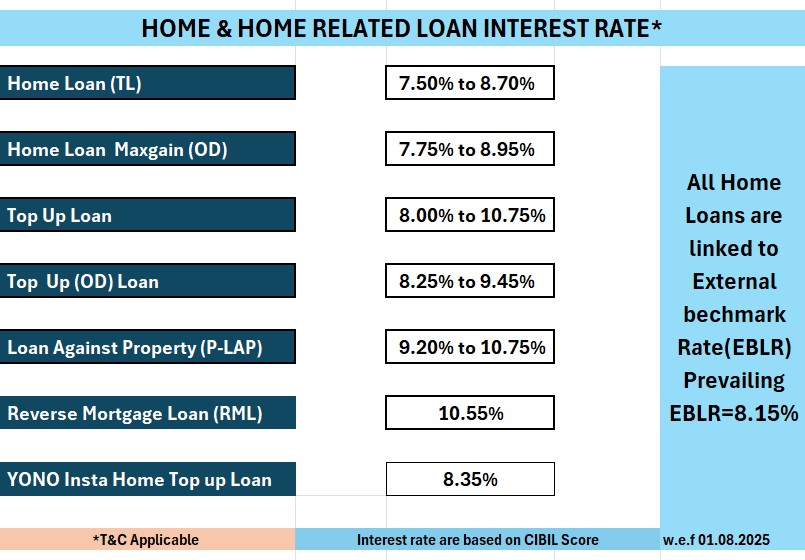
SBI’s home loan rates on 17 September 2026 range from 7.25% to 8.55%, linked to EBLR. On a ₹50 lakh loan over 20 years, 7.25% means an EMI of about ₹39,519. Personal loans range from 10.00% to 15.00%; a ₹5 lakh loan over 5 years at 10.00% costs about ₹10,624 a month. See the latest on our SBI home loan interest rate page, or run your own figures in the EMI calculator.
| MCLR tenor | Rate from 15 Sep 2026 |
|---|---|
| Overnight | 7.85% |
| One month | 7.85% |
| Three months | 8.25% |
| Six months | 8.60% |
| One year | 8.70% |
| Two years | 8.75% |
| Three years | 8.80% |
SBI left every MCLR tenor unchanged in its September 2026 review. MCLR is the benchmark for SBI loans that are not linked to EBLR, including many older floating-rate loans. Base rate (9.90%) and BPLR (14.65%) apply only to loans taken before those benchmarks were replaced.
Breaking an SBI FD early
If you close a retail FD before maturity, SBI pays interest at 0.50% below the rate that applied for the period the money stayed (deposits up to ₹5 lakh), or 1% below (above ₹5 lakh and below ₹2 crore). Deposits that stay less than 7 days earn no interest.
Frequently asked questions
What is the current SBI FD interest rate?
3.05% to 6.45% for the general public and 3.55% to 7.05% for senior citizens on deposits below ₹3 crore, effective 15 December 2025. The 2–3 year band pays 6.40% to the public.
What is the SBI MIS interest rate?
SBI’s monthly-income product is the Annuity Deposit Scheme, which earns the term deposit rate for 36, 60, 84 or 120 months. The Post Office MIS pays 7.4%, but only at post offices.
What is the SBI savings account interest rate?
2.50% a year on all balances, effective 15 June 2025, paid quarterly.
Does an SBI current account earn interest?
No. RBI rules do not allow banks to pay interest on current account deposits.
What is SBI’s home loan interest rate today?
7.25% to 8.55% as of 17 September 2026. Your rate depends on your credit score and loan type.
What is SBI’s MCLR in September 2026?
The one-year MCLR is 8.70% and the overnight MCLR is 7.85%, effective 15 September 2026 and unchanged in that review.
Sources
- Retail domestic term deposit rates — State Bank of India (checked 17 Sep 2026)
- Savings bank deposit rates — State Bank of India (checked 17 Sep 2026)
- MCLR effective 15 September 2026 — State Bank of India (checked 17 Sep 2026)
- External Benchmark based Lending Rate — State Bank of India (checked 17 Sep 2026)
- Base rate history — State Bank of India (checked 17 Sep 2026)
- BPLR history — State Bank of India (checked 17 Sep 2026)
- Deposit rates, interest calculation and premature withdrawal penalty — State Bank of India (checked 17 Sep 2026)
- Home loan interest rates — SBI Home Loans (checked 17 Sep 2026)
- Personal loan interest rates — State Bank of India (checked 17 Sep 2026)
- Annuity Deposit Scheme — State Bank of India (checked 17 Sep 2026)
- Recurring Deposit — State Bank of India (checked 17 Sep 2026)
- Interest Rate on National Savings Schemes — National Savings Institute (checked 17 Sep 2026)
- Master Direction on Interest Rate on Deposits — Reserve Bank of India (checked 17 Sep 2026)
Compare loans with live numbers
Compare interest rates, processing fees and eligibility across every lender in India — home loans, personal loans, gold loans, car loans, education loans and business credit. All-in cost, not just the teaser rate.
Related articles
-
RBI Raises Policy Repo Rate to 5.50% and Shifts Stance
The Reserve Bank of India has raised the policy repo rate by 25 basis points to 5.50 per cent and…
-
RBI Raises Policy Repo Rate to 5.50 Per Cent
The Reserve Bank of India raised the policy repo rate by 25 basis points to 5.50 per cent on…
-
RBI Increases Repo Rate to 5.50 Per Cent in October 2026
The Reserve Bank of India increased the policy repo rate by 25 basis points to 5.50 per cent during…
-
RBI Increases Policy Repo Rate to 5.50 Per Cent
The Reserve Bank of India raised the policy repo rate by 25 basis points to 5.50 per cent.