Mortgage loans in India allow borrowers to pledge property as collateral, offering attractive interest rates and long repayment tenures. As of June 2026, the RBI repo rate stands at 5.25%, influencing home loan rates that typically start from 7.25% p.a. For eligible salaried individuals.
| Parameter | Details |
|---|---|
| Definition of Mortgage Loan | A mortgage loan, also known as a home loan or loan against property, allows you to borrow money by pledging your property as collateral. This loan helps fund home purchases, renovations, or business needs with attractive interest rates and long repayment tenures. |
| Current Mortgage Loan Interest Rates in India (2026) | Mortgage loan interest rates in India currently vary between 9% and 20% p.a. (as of June 2026, MyMoneyMantra). |
| Starting Home Loan Interest Rates (2026) | Home loan interest rates in 2026 generally start from around 7.25% p.a. For eligible salaried borrowers (Bajaj Finserv), with some banks offering rates starting at 7.60%* p.a. (Kotak Mahindra Bank) or 7.50%* p.a. (ICICI Bank). |
| RBI Repo Rate (June 2026) | As of June 2026, the RBI repo rate stands at 5.25% (RBI), following a 25 basis point cut in December 2025. The RBI kept the repo rate unchanged at 5.25% in April 2026. |
| Factors Affecting Interest Rates | Interest rates depend on multiple factors such as credit score, loan amount, loan tenure, employment type (salaried or self-employed), income stability, lender’s internal risk assessment, macroeconomic factors (RBI monetary policy, inflation, economic growth), and existing relationship with the lender. |
| Types of Interest Rates | Home loans can have fixed-rate, floating-rate, or hybrid interest rates. Fixed rates remain constant, floating rates fluctuate based on benchmark rates (e.g., repo rate, MCLR), and hybrid rates are a mix of both. |
| Impact of RBI on Interest Rates | Any policies set forth by the RBI, including revisions in the benchmark rate, can directly impact the borrower’s EMI or loan tenure. Home lending rates in India are established and monitored by the Reserve Bank of India. |
| Average Housing Loan Interest Rate (2013-2023) | The typical annual housing loan interest rate in India over the past decade (from 2013 to 2023) stood at an average of 8.82%. |
| Mortgage Loan Margin (2026) | Most banks and financial institutions apply a mortgage loan margin of 40% to 60% (as of 2026). |
| Maximum Finance Against Property (2026) | Borrowers can avail up to 60% of the property’s registered value as maximum finance against property (as of 2026). |
| CIBIL Score for Loan Against Property (2026) | A CIBIL score of 700 and above is generally required for Loan Against Property applications (as of 2026). |
| Concessional Rates for Women (2026) | Women borrowers can often secure concessional home loan interest rates, typically 0.05% lower than standard rates (ClearTax, 2026). |
| Federal Reserve’s Key Interest Rate (Early May 2026) | The Federal Reserve’s key interest rate (federal funds rate) was between 3.5% to 3.75% in early May 2026. |
| Current Rate for 30-Year Mortgage (June 3, 2026) | The current rate for a 30-year mortgage was 6.472% as of June 3, 2026. |
| Average 15-Year Mortgage Rate (June 3, 2026) | The average 15-year mortgage rate was 5.850% as of June 3, 2026. |
Understanding these key facts about mortgage loan interest rates is for borrowers in India, as rates are influenced by RBI policies and individual credit profiles, directly impacting EMI payments.
Mortgage Loan Interest Rates: Types, Categories & Key Components Explained
Mortgage loan interest rates in India typically range from 9% to 20% p.a. As of June 2026, influenced by the RBI repo rate, which stands at 5.25%. Borrowers can choose between fixed, floating, or hybrid rate loans, with rates starting from around 7.25% p.a. For eligible salaried individuals.
| Type/Category | Details | Key Feature |
|---|---|---|
| Fixed Interest Rate Home Loan | Interest rate remains constant throughout the loan tenure. | Predictable monthly payments (EMIs). |
| Floating Interest Rate Home Loan | Interest rate fluctuates over time based on benchmark rates (e.g., repo rate, MCLR) as guided by the Reserve Bank of India. | Rates adjust with market conditions, potentially lowering EMIs if benchmark rates fall. |
| Hybrid Rate Home Loan | A mix of fixed-rate and floating-rate home loans. Initially has a fixed interest rate for a set period, then converts to a floating interest rate. | Initial stability with potential for market-linked adjustments later. |
| Home Loan (General) | Available for salaried and self-employed individuals, resident Indians and NRIs. Interest rates generally start from around 7.25% p.a. (June 2026). | Funds home purchases, renovations, or construction with attractive interest rates and long repayment tenures. |
| Mortgage Loan / Loan Against Property | Borrow money by pledging property as collateral. Interest rates in India vary between 9% and 20% p.a. (June 2026). | Funds home purchases, renovations, business needs, or debt consolidation using property as security. |
| Home Loan Balance Transfer | Allows borrowers to transfer their existing home loan to a new lender, often to avail lower interest rates. | Potential for reduced interest rates and EMIs. |
| Home Loan Top-up | An additional loan amount provided on an existing home loan, often at significantly lower interest rates than personal loans. | Access to additional funds at competitive rates using existing home loan collateral. |
| Commercial Loan (Fixed-rate) | Interest rate remains constant throughout the loan term, typically ranging from 11.80% to 13.30% or higher (June 2026). | Predictable monthly payments for business financing. |
| Loan Against Rent Receivables | Loan secured against future rental income from a property. Interest rates range from 9.50% to 11% (June 2026) for HDFC Bank. | uses rental income to secure funds for various needs. |
| Dropline Overdraft (against property) | A flexible credit facility linked to a property, where interest is charged only on the utilized amount of the sanctioned operating limit. Interest rates range from 9.50% to 11% (June 2026) for HDFC Bank. | Flexible access to funds with interest charged only on the drawn amount. |
| Repo-Linked Rate (Central Bank of India) | Calculated as Repo Rate + Spread (e.g., 5.25% + 3% = 8.25% as of June 2026). | Directly linked to RBI’s repo rate changes. |
| Concessional Home Loan for Women | Interest rates are typically 0.05% lower than standard rates for women borrowers. | Promotes home ownership among women. |
| Interest Rate Concession (Federal Bank) | Women borrowers with a Mahilamitra Plus savings account receive a concession. | Specific benefit for certain account holders. |
| Interest Subsidies (Government Schemes) | Available for eligible beneficiaries under schemes like Pradhan Mantri Awas Yojana (PMAY). | Reduces effective interest burden for specific segments. |
The effective interest rate on a mortgage loan is the sum of a benchmark rate and a lender-specific spread, with RBI revisions directly impacting EMIs or loan tenure.
Mortgage Loan Interest Rates: Key Statistics & Data Points for 2026
Mortgage loan interest rates in India for 2026 generally range from 7.10% to 13.20% p.a., influenced by the RBI repo rate, which stands at 5.25% as of June 2026. Salaried borrowers often secure rates starting from 7.25% p.a., while self-employed individuals typically see rates from 7.70% p.a.
| Metric | Value | Source |
|---|---|---|
| RBI Repo Rate (June 2026) | 5.25% | Reserve Bank of India (RBI) |
| Lowest Home Loan Interest Rate (Salaried, June 2026) | 7.25% p.a. | Bajaj Finserv |
| Lowest Home Loan Interest Rate (Self-employed, June 2026) | 7.70% p.a. | Bajaj Finserv |
| Mortgage Loan Interest Rate Range (India, 2026) | 7.10% to 13.20% p.a. | ClearTax |
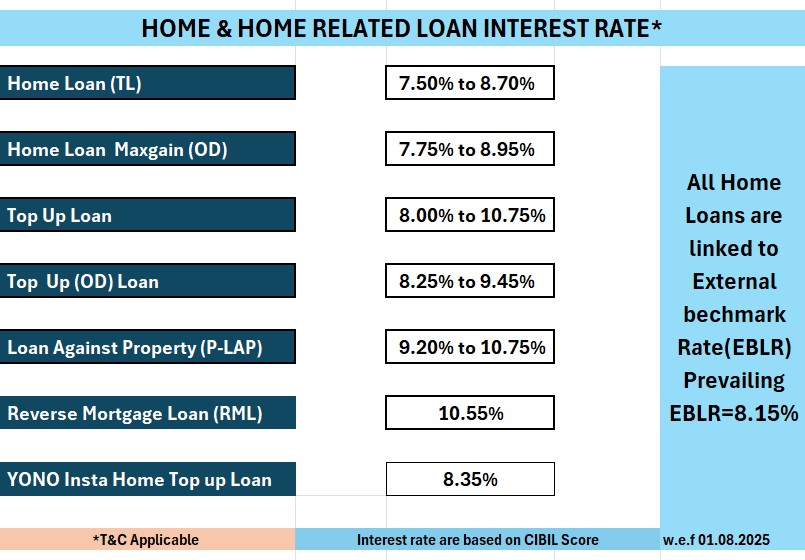
| Kotak Home Loan Interest Rate (Starting, 2026) | 7.60% p.a. | Kotak Mahindra Bank |
| ICICI Bank Home Loan Interest Rate (Starting, valid till May 31, 2026) | 7.50% p.a. | ICICI Bank |
| SBI Home Loan Interest Rate (Starting, 2026) | 8.5% p.a. | SBI |
| HDFC Bank Loan Against Property Interest Rate (2026) | 9.50% to 11% p.a. | HDFC Bank |
| CIBIL Score Required for Loan Against Property (2026) | 700 and above | Industry Standard |
| Maximum Finance Against Property (2026) | Up to 60% of property’s registered value | Industry Standard |
| Maximum Home Loan Amount (Bajaj Finserv, 2026) | Up to ₹15 Crore | Bajaj Finserv |
| Maximum Home Loan Repayment Tenure (Bajaj Finserv, 2026) | 32 years | Bajaj Finserv |
| Processing Fees (SBI, 2026) | 0.35% to 0.50% of loan amount | SBI |
| Processing Fees (ICICI Bank Home Loan, 2026) | 0.5% of loan amount + taxes | ICICI Bank |
| Delayed EMI Payment Interest (HDFC Bank LAP, 2026) | 18% per annum on overdue amount | HDFC Bank |
| Floating to Fixed Rate Conversion Fee (HDFC Bank LAP, 2026) | Up to ₹3,000 (one-time) | HDFC Bank |
| Interest Rate Concession for Women Borrowers (Federal Bank) | Available for Mahilamitra Plus savings accountholders | Federal Bank |
These rates and charges are subject to change based on market conditions, individual credit profiles, and lender policies, making IT to verify current figures directly with financial institutions.
How Mortgage Loan Interest Rates Work: Process, Steps & Key Details
Mortgage loan interest rates in India are determined by a benchmark rate and a lender-specific spread, forming the Effective Interest Rate (EIR). The Reserve Bank of India (RBI) monitors these rates, with the current repo rate at 5.25% as of June 2026.
Understanding the application process and factors influencing your rate is for securing favourable terms.
- Check Eligibility Criteria: Lenders like Kotak Mahindra Bank require salaried applicants to be between 18 and 60 years old, while self-employed individuals can be up to 65 years. Canara Bank mandates a minimum of 2 years of continuous service for salaried individuals.
- Assess Your CIBIL Score: A CIBIL score of 700 and above is generally required for mortgage loans, per 2026 standards. A strong credit history can help secure lower interest rates from banks like ICICI Bank.
- Gather Required Documents: Documentation varies for salaried and self-employed individuals. This typically includes identity proof, address proof, income statements, and property documents.
- Choose Between Fixed or Floating Rates: You can opt for a fixed rate, which remains constant, or a floating rate, which fluctuates with benchmark rates like the RBI repo rate. As of June 2026, the RBI repo rate is 5.25%.
- Compare Lender Rates and Fees: Home loan interest rates in India range from 7.10% to 13.20% p.a. (ClearTax, 2026). Compare processing fees, which can be up to 0.50% of the loan amount (e.g., Canara Bank, ICICI Bank).
- Understand Processing Fees: Processing fees vary by lender; for instance, SBI charges 0.35% to 0.50% of the loan amount, while Citibank charges up to ₹50,000 (2026). HSBC charges 1% of the loan amount or ₹10,000, whichever is higher.
- Consider Prepayment Charges: HDFC Bank allows one annual prepayment up to 25% of the outstanding principal without charge. Prepayments exceeding this limit incur a 2.5% fee plus GST.
- Look for Concessions and Subsidies: Federal Bank offers interest rate concessions for women borrowers with a Mahilamitra Plus savings account. Government schemes like Pradhan Mantri Awas Yojana (PMAY) provide interest subsidies for eligible beneficiaries.
By carefully evaluating these steps and details, borrowers can the mortgage loan process effectively and potentially reduce their overall interest burden in 2026.
Mortgage Loan Interest Rates: Benefits, Advantages & Why Students Choose IT
Mortgage loan interest rates in India typically range from 9% to 20% p.a. As of 2026, influenced by factors like credit score and loan tenure. These loans, also known as home loans or loans against property, help fund significant financial needs by pledging property as collateral.
- Lower Interest Rates: Mortgage loans generally offer lower interest rates compared to unsecured loans, making them a cost-effective financing option. For instance, home loan rates start from about 7.10% p.a. In June 2026.
- Longer Repayment Tenure: Borrowers can get extended repayment periods, often up to 32 years with lenders like Bajaj Finserv, which reduces the monthly EMI burden. This flexibility helps manage finances comfortably.
- Higher Loan Amounts: You can secure substantial funds, with some lenders like Bajaj Finserv offering up to ₹15 crore, or up to 60% of the property’s registered value. This allows for large-scale investments or purchases.
- Tax Benefits: Home loan borrowers can claim tax deductions on interest paid under Section 24(b) and on principal repayment under Section 80C of the Income Tax Act. This reduces the overall cost of the loan.
- Property Appreciation: Investing in property through a mortgage loan can lead to capital appreciation over time, building wealth for the borrower. The average annual housing loan interest rate in India was 8.82% from 2013 to 2023.
- Flexible Interest Rate Options: Borrowers can choose between fixed, floating, or hybrid interest rates based on their risk appetite and market outlook. Floating rates fluctuate with benchmark rates like the RBI repo rate, which was 5.25% in April 2026.
- Balance Transfer Facility: Existing mortgage loans can be transferred to new lenders offering lower interest rates, potentially saving a significant amount over the loan tenure. This is a common strategy to reduce interest costs.
These advantages make mortgage loans a preferred choice for individuals seeking substantial funds against their property at competitive rates and flexible terms.
Mortgage Loan Interest Rates: Vs Alternatives: Which Option is Best?
Mortgage loans in India offer interest rates starting from 7.10% p.a. (as of June 2026), significantly lower than Loan Against Property (LAP) which starts around 9.50% p.a. And commercial loans beginning at 11.80% p.a. The RBI repo rate, currently 5.25% (June 2026), directly influences these floating rates.
| Feature | Home Loan (Mortgage) | Loan Against Property (LAP) | Commercial Loan |
|---|---|---|---|
| Interest Rate Range (2026) | 7.10% to 13.20% p.a. | 9.00% to 20% p.a. | 11.80% to 13.30% p.a. Or higher |
| Minimum Interest Rate (2026) | 7.10% p.a. (starting) | 9.50% p.a. (HDFC Bank) | 11.80% p.a. |
| Maximum Interest Rate (2026) | 8.00% p.a. (Kotak) | 20% p.a. (MyMoneyMantra) | 13.30% p.a. Or higher |
| Purpose of Loan | Purchasing/constructing a residential property | Funding personal/business needs against existing property | Financing business operations, expansion, or commercial property |
| Loan-to-Value (LTV) Ratio | Up to 90% of property value | Up to 60% of property’s registered value | Varies by lender, often lower than LAP |
| Factors Affecting Rates | Credit score, loan amount, tenure, employment type, income stability, RBI repo rate, market conditions | Borrower’s eligibility, loan amount, tenure, lender’s policy, property value, creditworthiness | Market conditions, borrower’s creditworthiness, business financials |
| Types of Interest Rates | Fixed, Floating, Hybrid | Fixed, Floating | Fixed |
| RBI Repo Rate (June 2026) | 5.25% (directly linked for floating rates) | 6.50% (Policy Repo Rate for HDFC LAP, plus spread) | Not explicitly linked, but influenced by overall economic policy |
| Processing Fees (2026) | 0.35% – 0.50% of loan amount (SBI) | 0.5% of loan amount + taxes (ICICI Bank) | Varies by lender, typically 0.5% – 2% |
| Maximum Tenure | Up to 32 years (Bajaj Finserv) | 5-20 years (Finnable) | Typically 5-15 years |
| CIBIL Score Requirement | 750+ for best rates | 700 and above for eligibility | 700+ generally required |
| Prepayment Charges | Often nil for floating rates (individual borrowers) | 2.5% plus GST on excess amount (HDFC Bank, if >25% of principal) | Varies by lender, often applicable |
Home loans offer the most competitive interest rates and longest tenures for residential property financing, making them distinct from the higher-rate, shorter-tenure Loan Against Property and Commercial Loan options.
Common Misconceptions About Mortgage Loan Interest Rates
Many borrowers misunderstand how mortgage loan interest rates work, impacting their financial planning. For instance, a common belief is that fixed rates never change, but hybrid loans offer initial fixed periods before converting to floating rates.
Understanding these helps in making informed decisions for your home loan in 2026.
- Fixed Rates are Permanent: While fixed rates remain constant for a set period, some loans, especially hybrid ones, transition to floating rates after an initial fixed term. Always check the loan agreement for reset clauses.
- Repo Rate Changes Immediately Affect EMIs: RBI repo rate changes, like the 25 basis point cut in December 2025, are not always immediately reflected in EMIs. Lenders typically pass on cumulative effects after a specified period, such as on March 25, 2026, for changes announced in February and March.
- All Lenders Offer the Same Rates: Mortgage loan interest rates vary significantly across banks and NBFCs, ranging from 7.10% to 13.20% p.a. As of June 2026. Factors like your CIBIL score, income stability, and the lender’s internal risk assessment determine the final rate.
- Prepayment is Always Free: While some lenders allow one annual prepayment up to 25% of the outstanding principal without charge, exceeding this limit can incur fees. HDFC Bank, for example, charges 2.5% plus GST on excess prepayment amounts.
- Interest Rates are the Only Cost: Beyond the interest rate, borrowers face various charges like processing fees (e.g., SBI charges 0.35-0.50% of the loan amount), delayed EMI penalties (HDFC Bank charges 18% p.a. On overdue amounts), and conversion fees for switching between fixed and floating rates.
Clarifying these misconceptions helps borrowers accurately assess the true cost and flexibility of their mortgage loans.
What to Do Next: Actionable Steps
Securing a mortgage loan in India requires evaluating interest rates, eligibility, and documentation. As of June 2026, home loan interest rates typically start from 7.25% p.a. For eligible salaried borrowers, varying by lender and credit profile.
- Check Your CIBIL Score: A CIBIL score of 700 and above is generally required for favourable mortgage loan interest rates. Lenders offer customised rates based on your credit history.
- Compare Lender Rates: Research current interest rates from various banks like SBI, HDFC Bank, ICICI Bank, and Kotak Mahindra Bank. Rates can range from 7.10% to 13.20% p.a. As of June 2026.
- Verify Eligibility Criteria: Confirm specific age and employment requirements. For instance, Kotak Mahindra Bank requires salaried applicants to be 18-60 years old and self-employed applicants 18-65 years old (2026).
- Prepare Required Documents: Gather necessary documents based on your employment status (salaried or self-employed). This includes income proof, identity, and property papers.
- Understand Fees and Charges: Account for processing fees, which can range from 0.35% to 0.50% of the loan amount (e.g., SBI, Canara Bank, ICICI Bank, 2026). HDFC Bank charges 18% p.a. On delayed EMI payments.
- Explore Government Schemes: Investigate interest subsidies available through government initiatives like Pradhan Mantri Awas Yojana (PMAY) for eligible beneficiaries. Federal Bank also offers interest rate concessions for Mahilamitra Plus savings accountholders.
By following these steps, you can effectively the mortgage loan application process and secure competitive interest rates in 2026.
Key Takeaways
- Mortgage loan interest rates in India for 2026 typically start around 7.25% p.a. For salaried individuals, influenced by credit score and lender.
- A CIBIL score of 700+ is for accessing lower interest rates and favourable loan terms from most Indian banks.
- Processing fees generally range from 0.35% to 0.50% of the loan amount, with additional charges for delayed payments or rate conversions.
Compare current mortgage loan interest rates and check your eligibility with leading banks on their official websites.
Frequently Asked Questions (FAQs)
What are the current mortgage loan interest rates in India for June 2026?
As of June 2026, mortgage loan interest rates in India generally start from about 7.25% p.a. For eligible salaried borrowers. Rates can vary by lender, your credit profile, and the specific loan amount. For instance, Bajaj Finserv offers rates starting at 7.25% p.a., while Kotak Bank starts at 7.60% p.a.
How does my CIBIL score affect my mortgage loan interest rate?
A higher CIBIL score typically helps you secure a lower mortgage loan interest rate. Lenders view a score above 750 as low-risk, often qualifying you for the most attractive rates. A history of missed payments or a lower score can lead to higher interest rates or even loan rejection.
What is the RBI repo rate in June 2026 and how does IT impact home loans?
The RBI repo rate stands at 5.25% as of June 2026, following a 25 basis point cut in December 2025. This benchmark rate influences the floating interest rates offered by banks and NBFCs on mortgage loans. A stable or lower repo rate can help keep your home loan EMIs unchanged or reduce them.
What is the difference between fixed and floating mortgage interest rates?
A fixed mortgage interest rate remains constant throughout the loan tenure, providing predictable EMI payments. A floating rate, however, changes periodically based on market conditions and the lender’s benchmark rate, such as the RBI repo rate. You can choose between these options based on your risk appetite and market outlook.
What factors determine the final mortgage loan interest rate I get?
Your final mortgage loan interest rate depends on several factors, including your CIBIL score, repayment history, income stability, and employment type (salaried or self-employed). The loan amount, tenure, and the lender’s internal risk assessment also play a significant role. Self-employed borrowers might see rates starting from 7.70% p.a. From some lenders.
Can NRIs apply for mortgage loans in India, and what are the interest rates?
Yes, Resident Indians and NRIs are both eligible to apply for mortgage loans in India. Interest rates for NRIs are generally similar to those for resident Indians, starting from around 7.25% p.a. In June 2026, but specific eligibility and documentation requirements may differ by lender.
What is the maximum repayment tenure for a mortgage loan in India?
Many lenders in India offer long repayment tenures for mortgage loans, typically extending up to 30 years. Some banks, like Bajaj Finserv, even allow repayment over 32 years, which helps in managing monthly EMIs comfortably. A longer tenure can reduce your EMI but increases the total interest paid over the loan’s life.
Disclaimer: This article is general information, not financial advice. Interest rates, fees, and eligibility change frequently. Verify current details with the lender or regulator (RBI / SEBI) before deciding.