The ten richest Indians right now
Forbes counts 209 Indian billionaires, holding about $1.02 trillion between them. Ten of them hold roughly a third of it. The list is a live one — these fortunes are revalued every trading day — and the gap between the top two is now narrower than it has been in years.
Written by
Published 21 September 2026
01 Mukesh Ambani
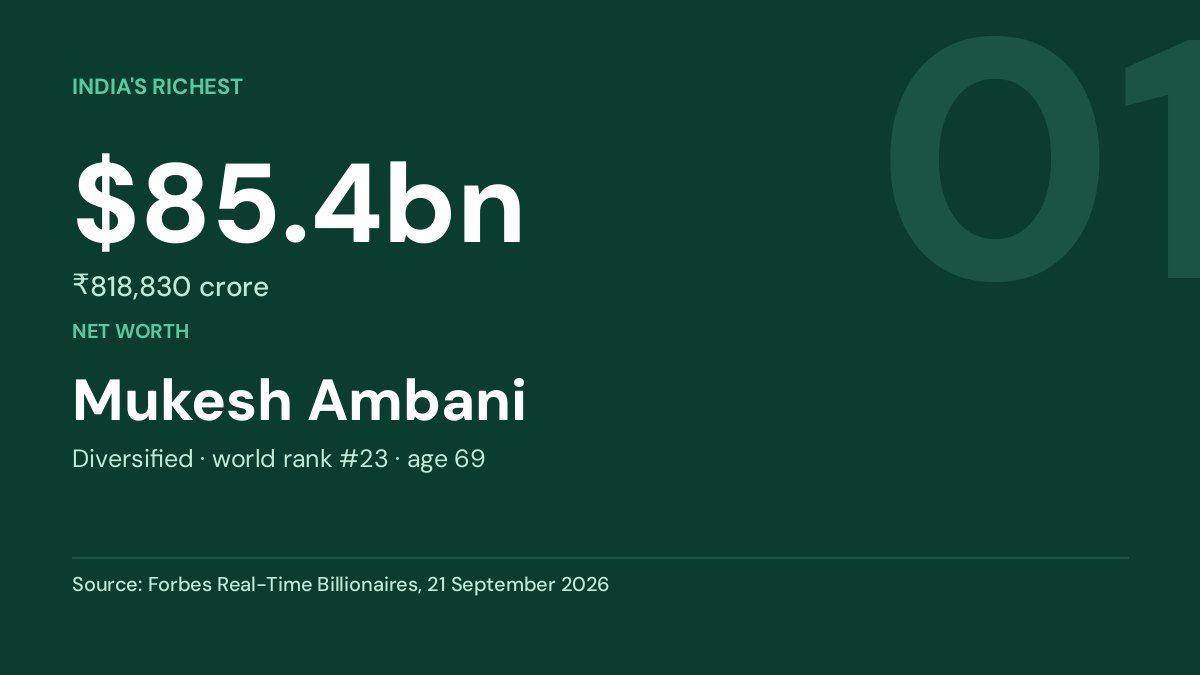
Net worth $85.4bn ₹818,830 crore
Reliance began as a polyester trader and now earns from refining, petrochemicals, telecom and groceries, which is why Forbes files him under "diversified" rather than any one industry. At $85.4bn he is #23 in the world and the richest person in Asia. Jio alone claims more subscribers than the population of the United States.
Source: Forbes Real-Time Billionaires · as of 21 September 2026
02 Gautam Adani
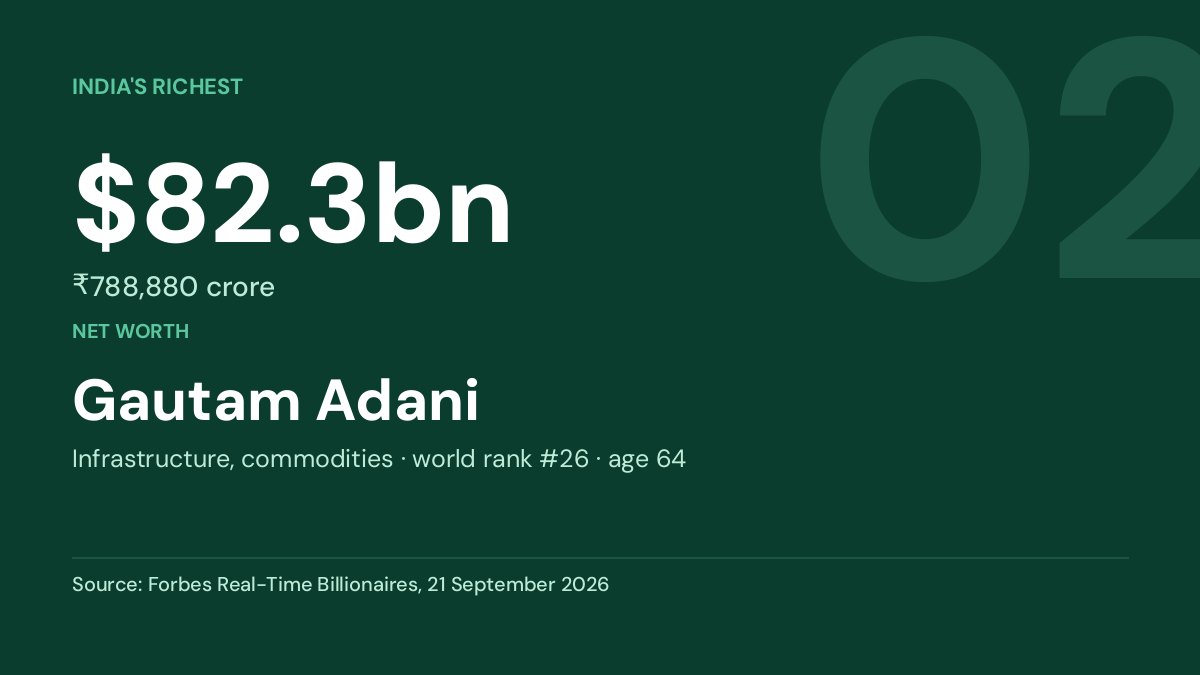
Net worth $82.3bn ₹788,880 crore
Ports, coal, airports, cement and power transmission — the Adani group builds the infrastructure other companies rent. $82.3bn puts him within a few billion of Ambani, and the pair have traded the top spot before. The group's listed value fell sharply after a 2023 short-seller report and has since recovered.
Source: Forbes Real-Time Billionaires · as of 21 September 2026
03 Savitri Jindal & family
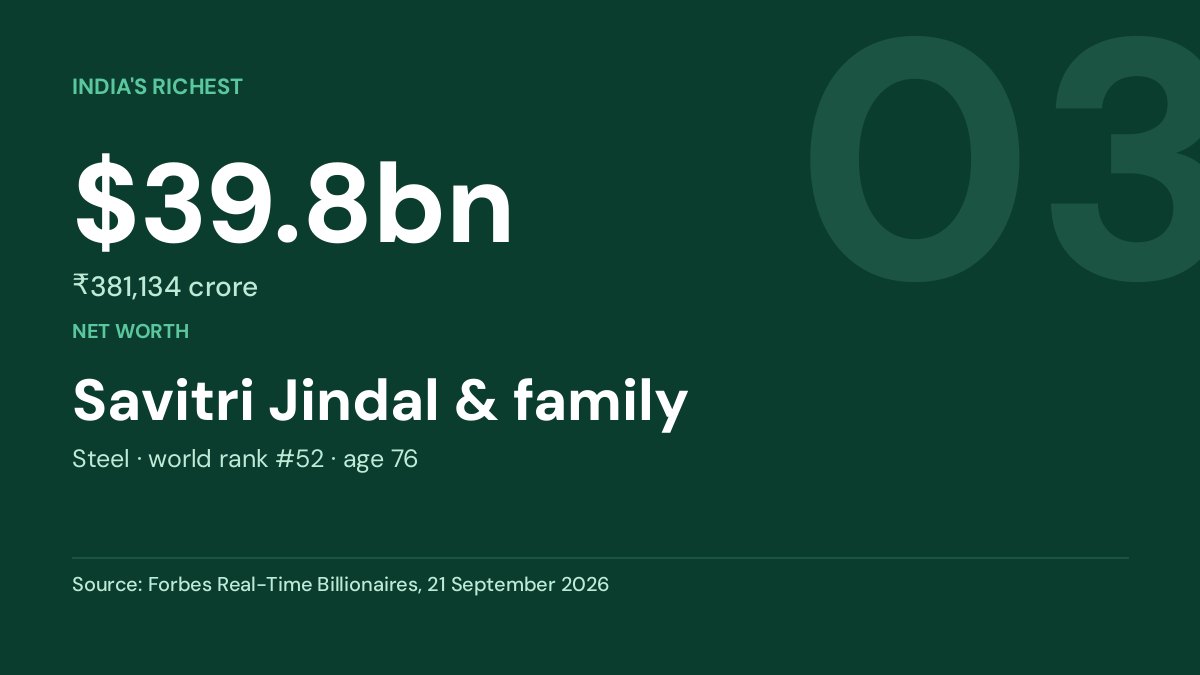
Net worth $39.8bn ₹381,134 crore
The richest woman in Asia, and the only woman in India's top ten. Her husband O. P. Jindal built the steel group; she took over the family's stake after his death in a 2005 helicopter crash, aged 76 now, and the businesses are run by her four sons. $39.8bn across the family holding.
Source: Forbes Real-Time Billionaires · as of 21 September 2026
04 Lakshmi Mittal
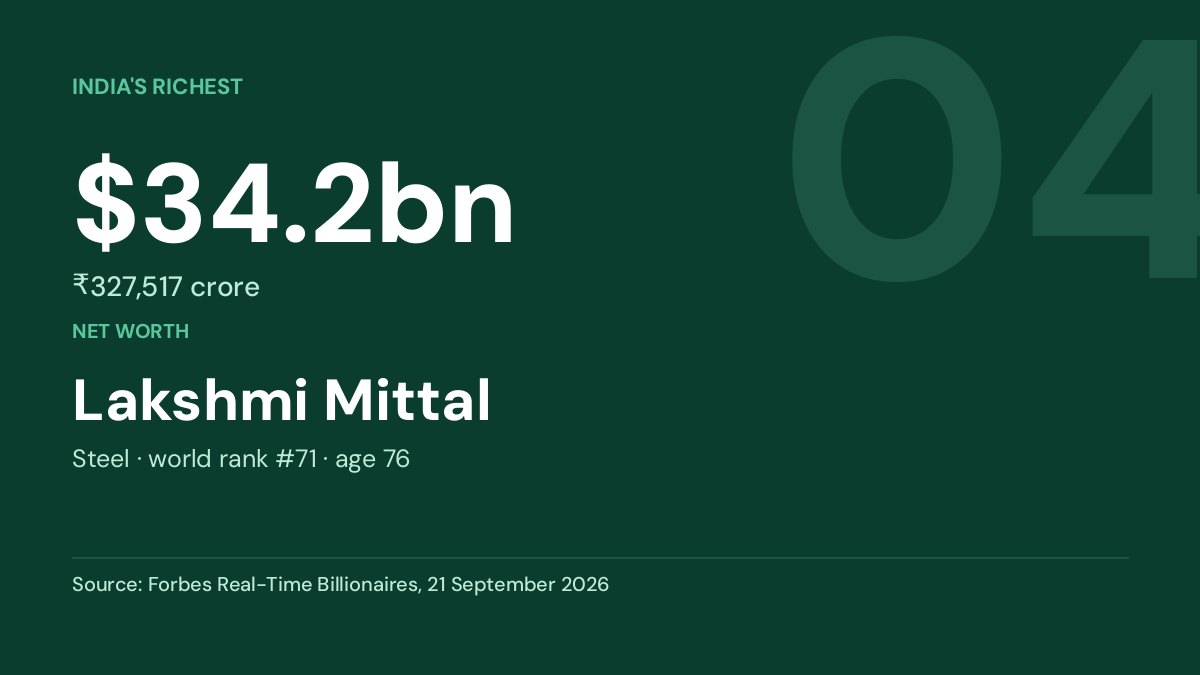
Net worth $33.7bn ₹323,328 crore
ArcelorMittal is the largest steelmaker outside China, and Mittal has run it from London for decades — Forbes still counts him as an Indian citizen. $33.7bn. His fortune moves with the steel cycle more sharply than anyone else's on this list, which is why his rank swings by dozens of places year to year.
Source: Forbes Real-Time Billionaires · as of 21 September 2026
05 Shiv Nadar
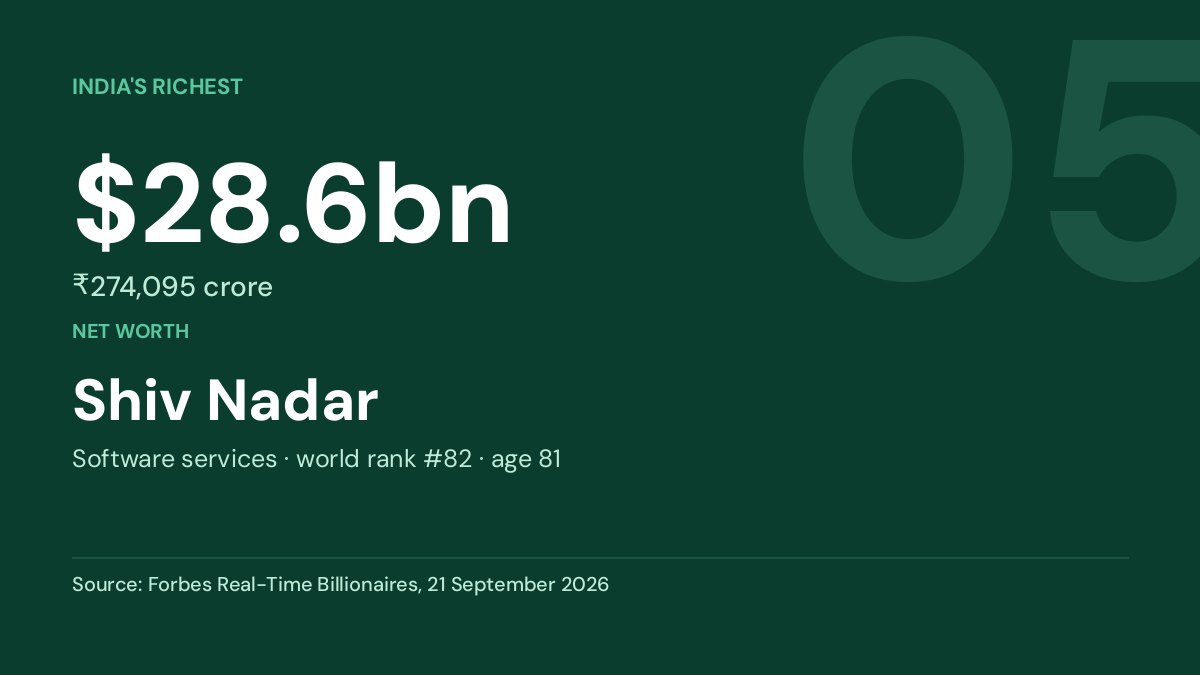
Net worth $28.6bn ₹274,095 crore
HCL started in 1976 making calculators and became one of India's big three IT services firms. At 81 Nadar has handed the chair to his daughter Roshni, the first woman to lead a listed Indian IT company. He is also India's most consistent large-scale philanthropist, giving away well over a billion dollars.
Source: Forbes Real-Time Billionaires · as of 21 September 2026
06 Cyrus Poonawalla
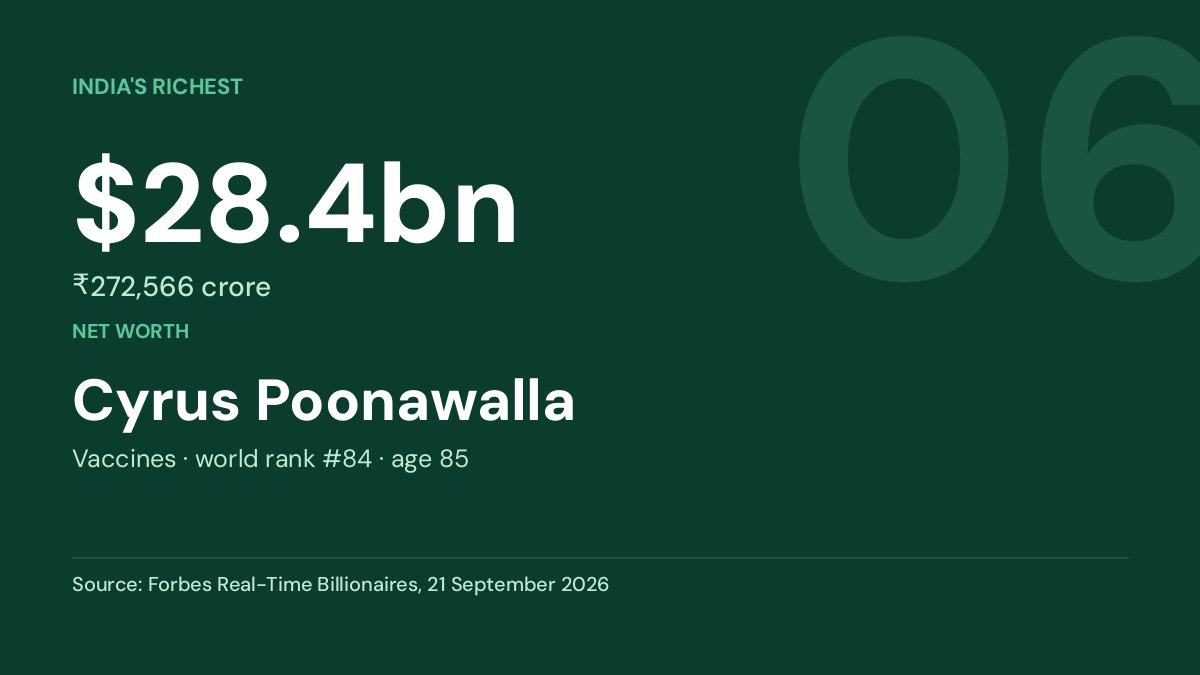
Net worth $28.4bn ₹272,566 crore
The Serum Institute of Pune makes more vaccine doses than any other company on earth, and it was built on the proceeds of a stud farm — the family bred racehorses first. $28.4bn at 85. Serum supplied a large share of the world's Covid-19 doses under the Covishield licence.
Source: Forbes Real-Time Billionaires · as of 21 September 2026
07 Dilip Shanghvi
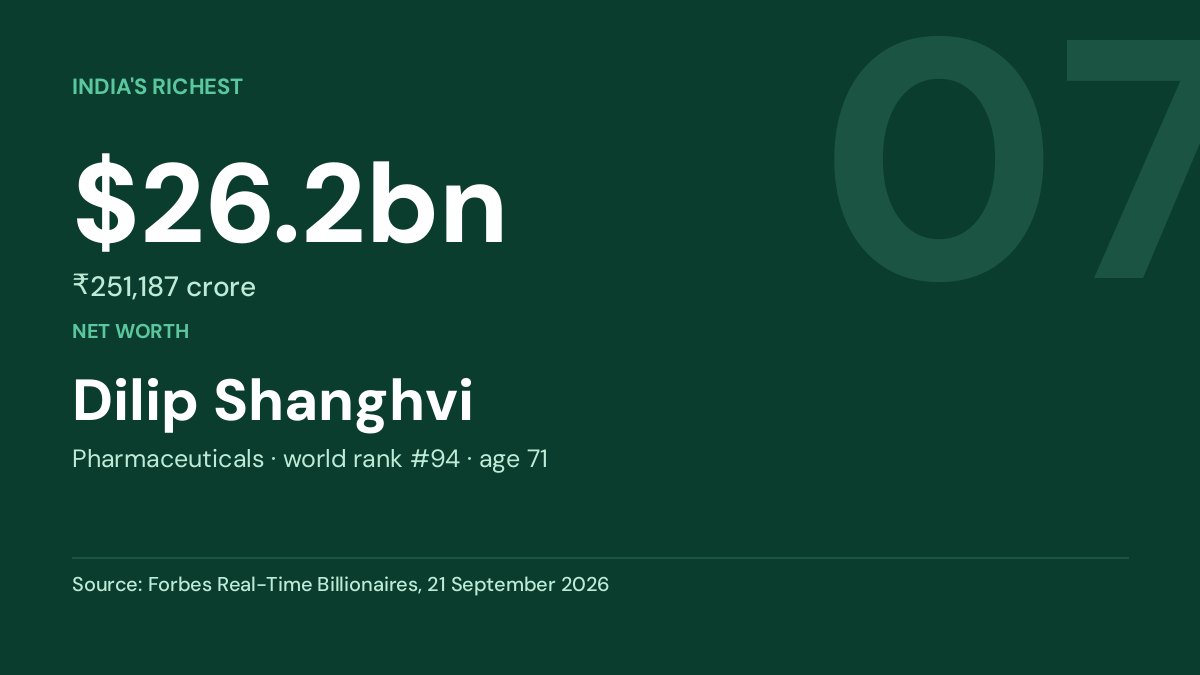
Net worth $26.2bn ₹251,187 crore
Sun Pharma started in 1983 with five psychiatric products and a ₹10,000 loan from his father, and is now India's largest drugmaker by revenue. $26.2bn. Shanghvi grew it largely by buying distressed rivals, including the much bigger Ranbaxy in 2014.
Source: Forbes Real-Time Billionaires · as of 21 September 2026
08 Kumar Birla
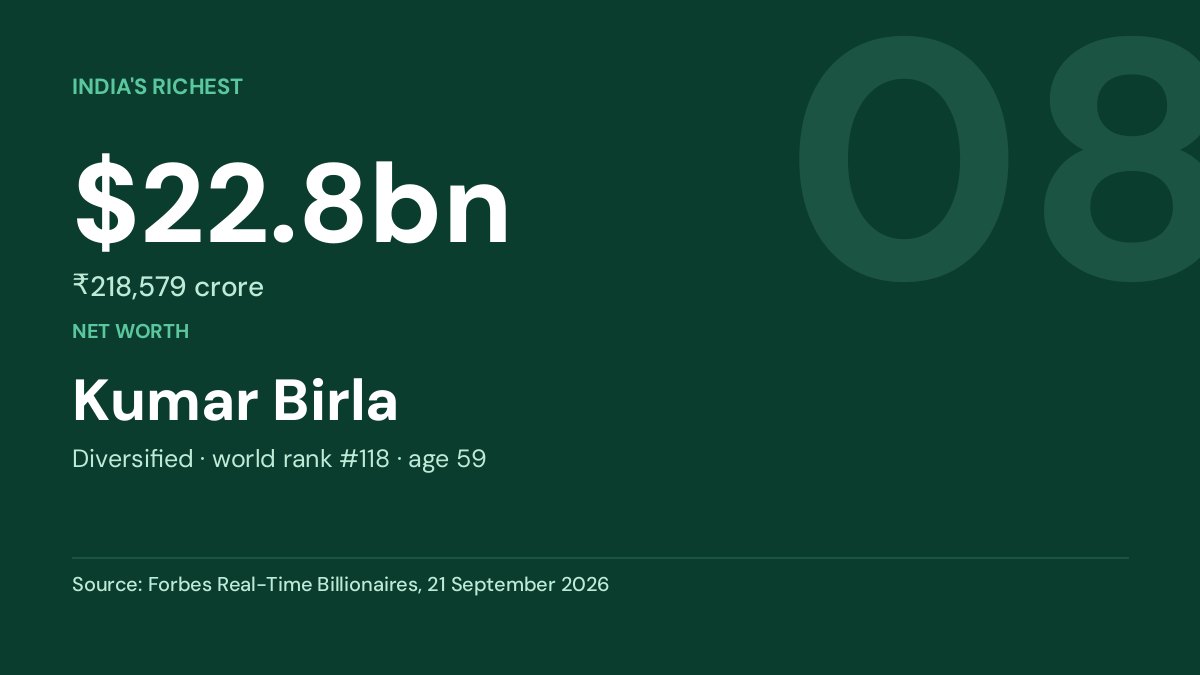
Net worth $22.8bn ₹218,579 crore
He took over the Aditya Birla Group at 28 when his father died, and has spent the years since buying: Novelis, Columbian Chemicals, Ultratech's cement rivals, Vodafone India. $22.8bn spans metals, cement, financial services and fashion retail across more than thirty countries.
Source: Forbes Real-Time Billionaires · as of 21 September 2026
09 Radhakishan Damani
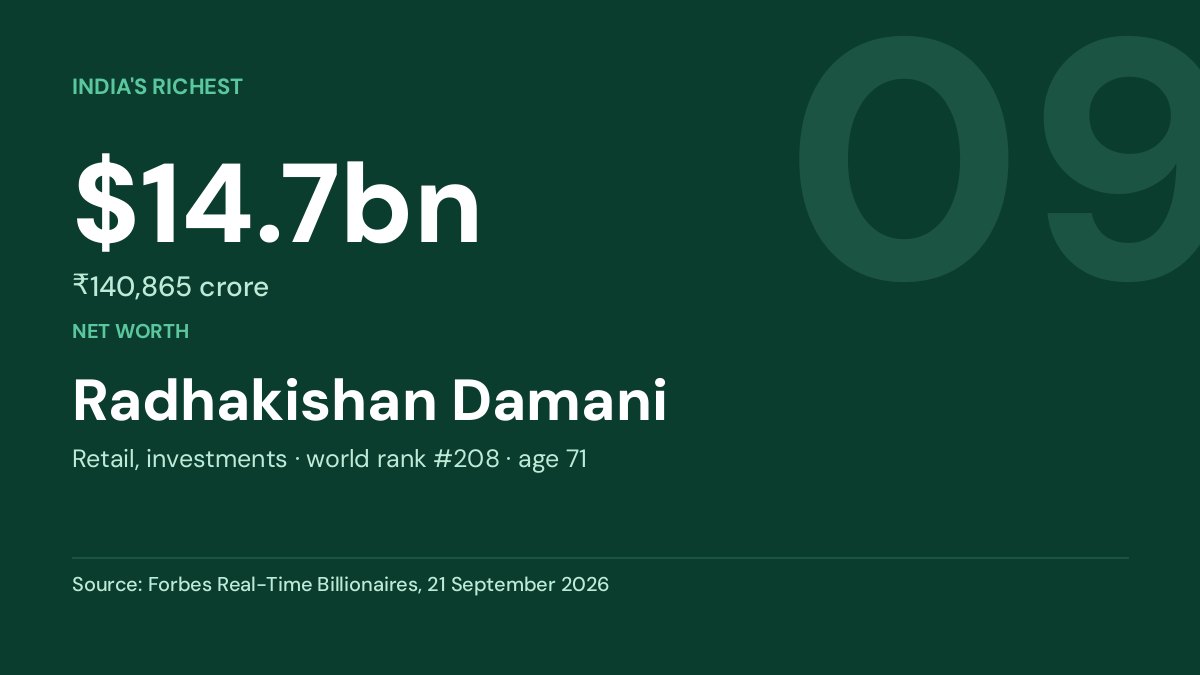
Net worth $14.7bn ₹140,865 crore
He was a stock market investor first and a shopkeeper second. DMart's Avenue Supermarts opened in 2002 on a deliberately unfashionable model — own the property, stock fewer lines, undercut everyone — and listed in 2017 at more than double its issue price on day one. $14.7bn.
Source: Forbes Real-Time Billionaires · as of 21 September 2026
10 Murali Divi & family
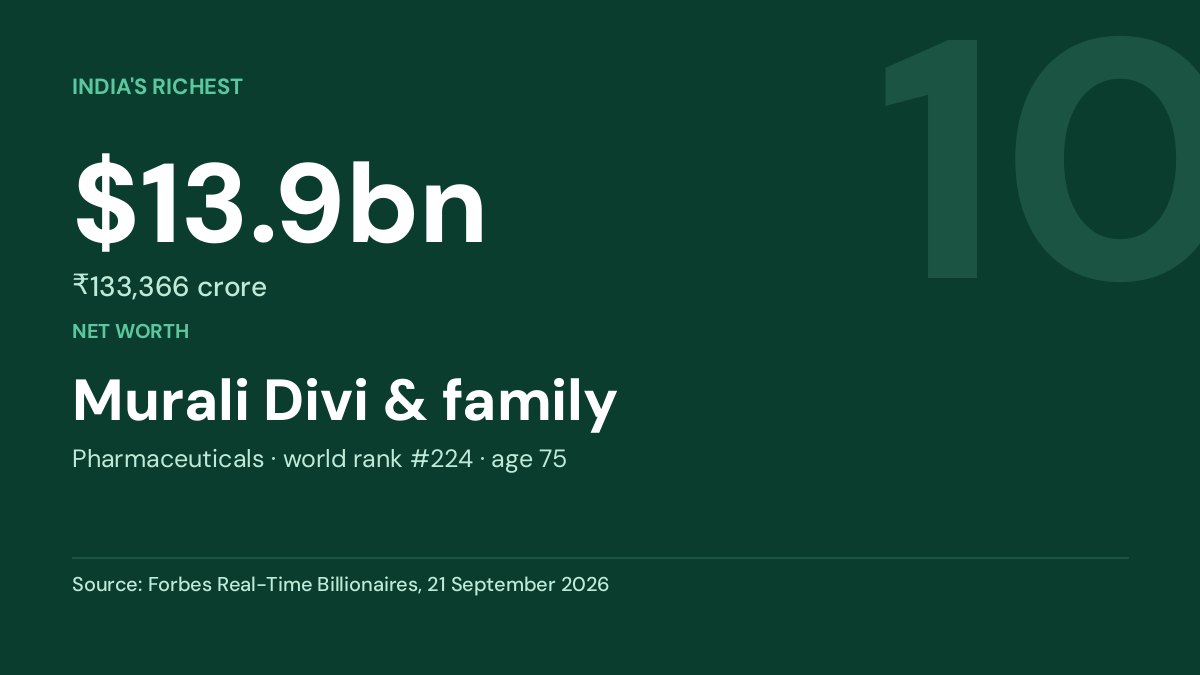
Net worth $13.9bn ₹133,366 crore
Divi's Laboratories does not sell medicines under its own name. It makes the active ingredients other pharmaceutical companies put in theirs, from two plants in Andhra Pradesh, and supplies most of the world's large drugmakers. $13.9bn at 75.
Source: Forbes Real-Time Billionaires · as of 21 September 2026
What compounding actually does
None of this list got there on a salary. The arithmetic that built it — a return, reinvested, over decades — is the same arithmetic in a SIP calculator.
Open the SIP calculatorMore like this
From Reliance to Hindustan Unilever: what one day did to India’s 10 biggest stocks
These 10 companies carry most of the weight in the Nifty 50, which means they carry most of the weight in…
21 September 2026
From Rishabh Pant to Virat Kohli: what IPL 2026 pays its 10 best-paid Indians per match
Ten Indian cricketers will earn more from fourteen league matches than most people earn in a lifetime. These…
21 September 2026
The ten richest women in India
Twenty of India's 209 billionaires are women. Most inherited what they hold; two built it. This is the top…
21 September 2026
The ten Indian cities that hallmark the most gold
India has 695 operative assaying and hallmarking centres on the BIS register, and ten cities hold 383 of them…
21 September 2026